Programmatic SEO Without Spam: When Template Pages Work
When template-generated pages help searchers and when they become scaled content abuse, the conditions for doing programmatic SEO well, and a small-batch process to test it.
Gunakesh Parmar ·
When template-generated pages help searchers and when they become scaled content abuse, the conditions for doing programmatic SEO well, and a small-batch process to test it.
Gunakesh Parmar ·
What Google has documented about AI Overviews, and six steps to be cited in them: eligibility, ranking for sub-questions, usable passages, expertise, query checks and measuring clicks.
Gunakesh Parmar ·
Where voice assistants get their spoken answers, why they now overlap with AI answers, and how to be the answer: short direct sentences, natural questions, complete listings and Indian language pages.
Gunakesh Parmar ·
How hotels, homestays and tour operators compete with booking platforms in search and AI trip planning: complete profiles, detailed room and itinerary pages, clear policies, reviews and local guides.
Gunakesh Parmar ·
How a new company can show experience, expertise and trust before it has case studies: visible people, publishable work, transparency and early independent signals.
Gunakesh Parmar ·
What a trustworthy About page includes, how to replace adjectives with checkable facts, how to connect it with structured data, and why AI assistants rely on it to describe your company.
Gunakesh Parmar ·
How search intent works now that questions carry conditions, continue across turns and mix several goals, how to identify it for any query, and which page format matches each intent.
Gunakesh Parmar ·
How businesses with several locations win local search and AI answers: one verified profile per real location, unique location pages, crawlable store locators, per-location reviews and consistency.
Gunakesh Parmar ·
A page-by-page method for refreshing existing content: building an inventory, deciding to update, merge, redirect, remove or leave, what a real update includes, and how to measure it.
Gunakesh Parmar ·
How Indian law firms and advocates can build search and AI visibility within the Bar Council of India's rules: factual profiles, practice areas, legal explainers and a crawlable disclaimer.
Gunakesh Parmar ·
What Indian banks, NBFCs, fintechs and advisers need to rank and be cited: dated rates and fees, RBI, SEBI and IRDAI disclosures, expert content, calculators and consistent listings.
Gunakesh Parmar ·
Anthropic's three user agents explained, and six steps to be found and cited by Claude: access, readable HTML, precise answers, shareable pages, consistency and measurement.
Gunakesh Parmar ·
Short, self-contained definitions of 62 terms used in answer engine optimisation, generative engine optimisation and technical SEO, with links to in-depth guides.
Gunakesh Parmar ·
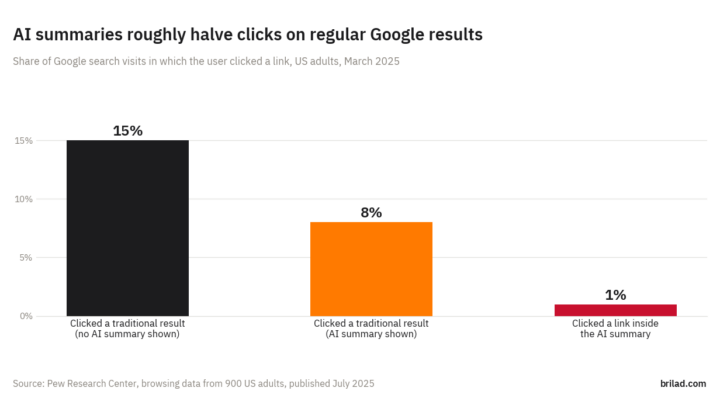
What Pew's click data shows, how retrieval-augmented generation decides which sources an assistant credits, the four stages companies move through from absent to recommended, and the order of work that actually pays off.
Gunakesh Parmar ·
What Indian hospitals, clinics and health brands need to rank and be cited: verifiable doctor profiles, reviewed treatment pages, costs and insurance, listings, and compliance with advertising and data rules.
Gunakesh Parmar ·
The pages, review profiles and documentation B2B SaaS companies need to be shortlisted by Google and AI assistants: use cases, integrations, pricing, comparisons and public docs.
Gunakesh Parmar ·
How Indian D2C brands can win organic and AI visibility against marketplaces: original product pages, legal disclosures, structured data, Merchant Center, category pages and guides.
Gunakesh Parmar ·
How Indian companies can become visible to buyers in the US, UK and Middle East: when to create market versions, URL structures, localised content, hreflang, local proof and measurement.
Gunakesh Parmar ·
A before, during and after checklist for redesigns, platform changes and domain moves that keeps search traffic: redirect mapping, content carry-over, staging traps and monitoring.
Gunakesh Parmar ·
Why Microsoft Copilot depends on Bing's index, and seven steps to appear in its answers: Bing Webmaster Tools, IndexNow, Bingbot access, content, schema, Bing Places and measurement.
Gunakesh Parmar ·
How Google Gemini finds information, why the Google-Extended setting matters, and six steps to appear in Gemini's answers through Search, Maps, YouTube and a clear entity.
Gunakesh Parmar ·
How Perplexity finds and cites sources, and six steps to become one of them: crawler access, citable sentences, freshness, ranking for sub-questions, presence on cited sites and measurement.
Gunakesh Parmar ·
A step-by-step guide to appearing as a source in ChatGPT search: OpenAI's crawlers, access, readable content, answering buyer questions, search visibility and measurement.
Gunakesh Parmar ·
The structure of a service page that serves buyers, Google and AI assistants: a specific opening, fit, deliverables, process, price, evidence and real FAQs.
Gunakesh Parmar ·
What Google has actually documented about AI Mode, what remains guesswork, and five strategy decisions that follow from the facts.
Gunakesh Parmar ·
The exact internal linking rules behind brilad.com: hubs, pillars, guides, services and blog posts, and how to apply the same hub-and-spoke structure to any site.
Gunakesh Parmar ·
A step-by-step method to find pages competing for the same queries using Search Console and a spreadsheet, and a decision table for merging, refocusing or redirecting them.
Gunakesh Parmar ·
A step-by-step diagnostic for traffic lost in a Google core update: confirming the cause, finding the losing pages and queries, studying the winners and deciding what to improve.
Gunakesh Parmar ·
A method for mapping the sub-questions AI assistants search when they answer a buyer's question, and assigning each one to a page, with a worked example.
Gunakesh Parmar ·
How to build a topic map that shows search engines and AI assistants your depth on a subject: core topics, buyer questions, page types, internal links and publishing order.
Gunakesh Parmar ·
Fifty SEO audit checks for 2026 in seven areas, from crawling and rendering to structured data, AI search readiness and measurement, with the tool for each.
Gunakesh Parmar ·
A step-by-step AEO playbook: choosing winnable queries, matching snippet formats, writing answer blocks, covering People Also Ask, and a 30-point checklist.
Gunakesh Parmar ·
A 100-point framework to assess how ready a website is for AI search, across crawler access, rendering, entity clarity, content, original information, off-site presence and measurement.
Gunakesh Parmar ·
Ten common problems in business website copy that stop AI assistants from quoting it, each with a before-and-after rewrite and the principle behind it.
Gunakesh Parmar ·
Which AI crawlers an Indian business should allow or block, by type of business, with robots.txt examples and the legal context in India.
Gunakesh Parmar ·
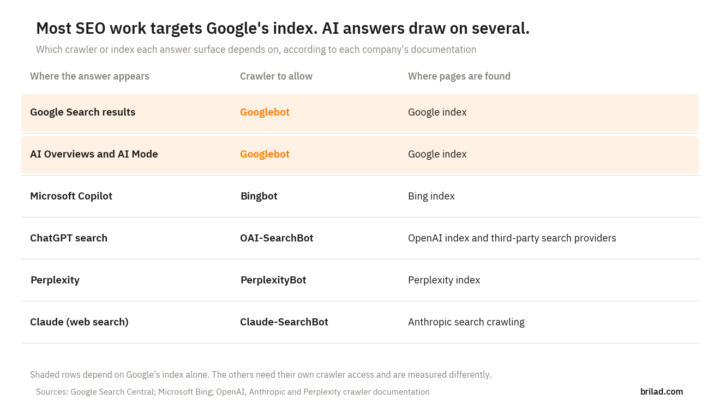
What Google, Microsoft and OpenAI say about structured data and AI answers, which schema types still produce results, and where schema causes problems.
Gunakesh Parmar ·
What really changes when you move from SEO to generative engine optimisation, what stays the same, and where to start, based on documentation from Google and OpenAI and published studies.
Gunakesh Parmar ·
What changes in answer engine and generative engine optimisation for B2B software, e-commerce, healthcare, financial services and market research publishers, based on documented guidance and published research.
Gunakesh Parmar ·
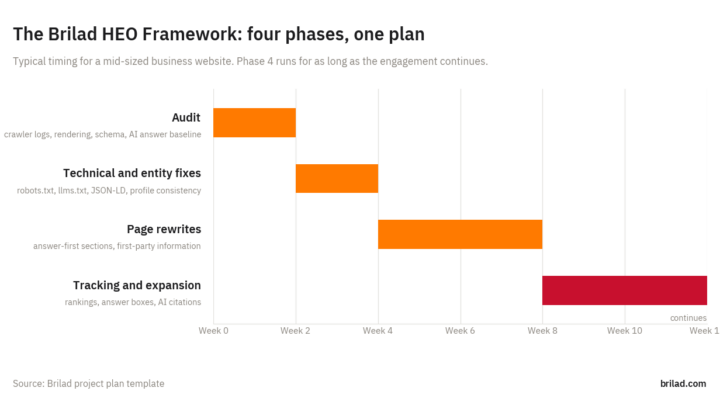
How Brilad plans SEO, answer engine optimisation and generative engine optimisation as one four-phase process, what each phase covers, and what it cannot promise.
Gunakesh Parmar ·