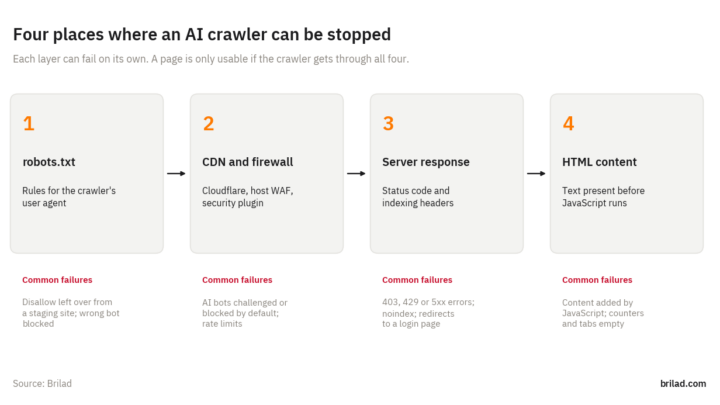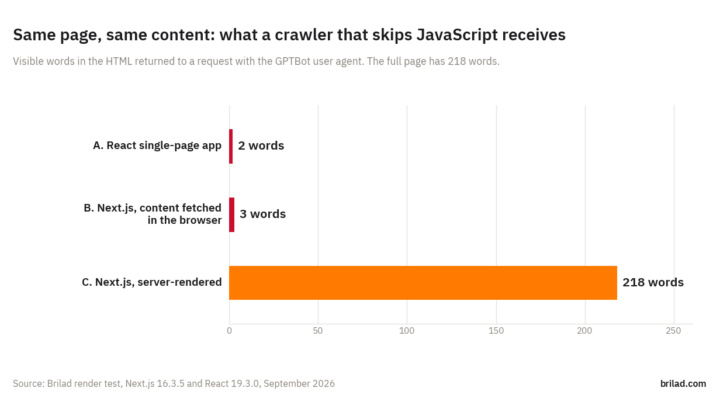
SEO is the work of getting your pages to rank in search results. GEO, generative engine optimisation, is the work of getting your brand named and cited inside answers written by AI assistants such as ChatGPT, Perplexity, Gemini and Google’s AI Overviews. Most of the work overlaps: Google says there are no special optimisations needed for its AI features beyond normal SEO. What changes is the unit that competes (a passage instead of a page), the number of indexes you need to reach, the weight of what other sites say about you, and how you measure success.
SEO and GEO side by side
| SEO | GEO | |
|---|---|---|
| Goal | Rank a page for a query | Be named or cited in an AI answer |
| What competes | Whole pages | Passages of a few sentences, and the brand itself |
| Where results come from | Mainly Google’s index | Google’s, Bing’s and each AI company’s own crawling |
| Crawlers that matter | Googlebot, Bingbot | Also OAI-SearchBot, PerplexityBot, Claude-SearchBot |
| Off-site signals | Mostly links | Mentions of your brand in context, reviews, profiles |
| Content style | Covers the topic and the query intent | Also answers each sub-question directly, in quotable form |
| Main measurement | Rankings, impressions, clicks | Mentions, citations and accuracy across assistants |
| Measurement tools | Search Console, analytics | Repeated prompt tests; referral data from AI tools |
| How stable results are | Fairly stable day to day | Answers vary between runs and users |
Does SEO still matter for GEO?
Yes, more than most GEO sales pitches suggest. Three pieces of evidence point the same way:
- Google’s documentation on AI features states that SEO best practices remain relevant for AI Overviews and AI Mode, and that there are no additional requirements or special optimisations needed to appear in them. A page must be indexed and eligible to show with a snippet.
- OpenAI’s publisher FAQ says any public website can appear in ChatGPT search, and that the main requirement is not blocking OAI-SearchBot.
- A study by Seer Interactive, which ran 10,000 finance and SaaS questions through ChatGPT, found a correlation of about 0.65 between ranking on page one of Google and being mentioned in the answers. Bing rankings correlated at around 0.5 to 0.6. Backlinks showed a weak relationship.
A correlation of 0.65 is strong but far from complete. Ranking well makes a mention more likely; it does not guarantee one. That gap is where GEO work adds something.
What actually changes
1. The unit that competes is a passage
AI assistants retrieve pages, pick passages from them and write an answer from those passages. A page that ranks well but spreads its answer across several paragraphs can lose to a page with one clear, self-contained passage. GEO work rewrites key sections so that each answers one question in its first sentence. The mechanics are covered in our guides to retrieval-augmented generation and content chunking.
2. You need to reach more than one index
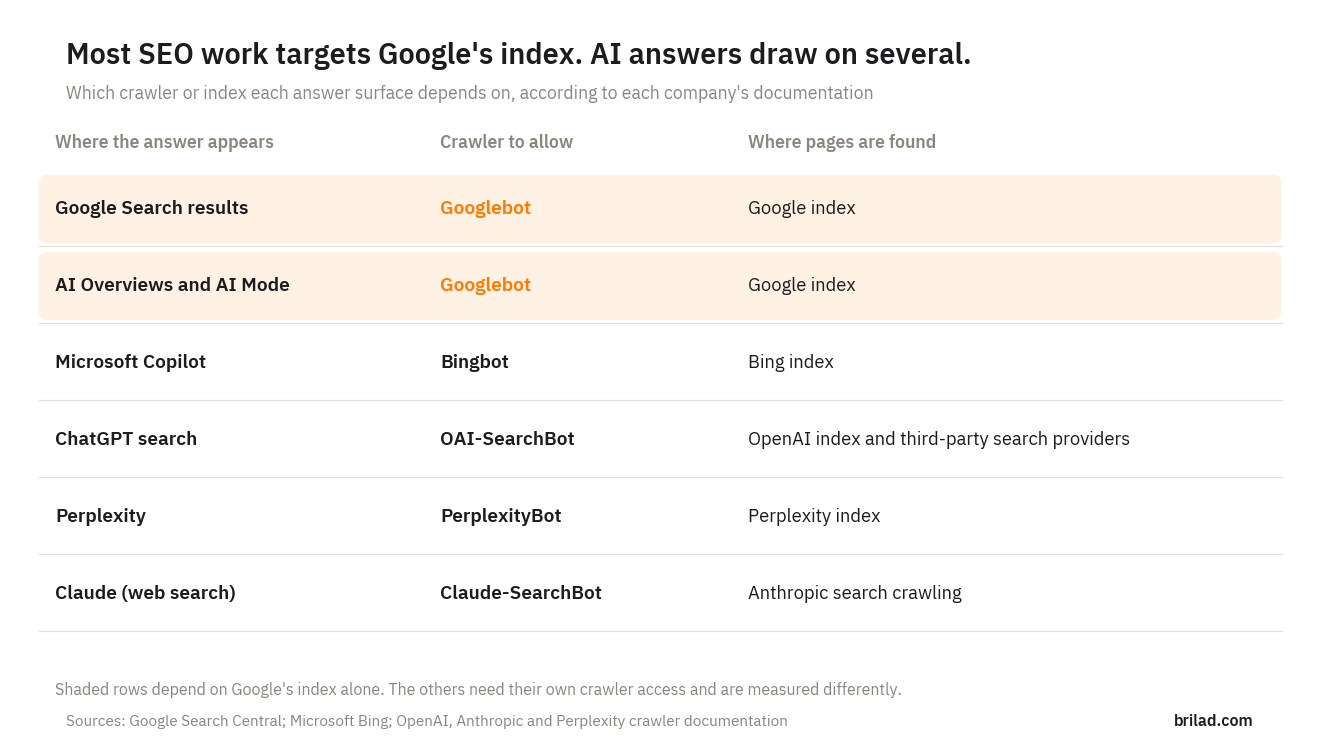
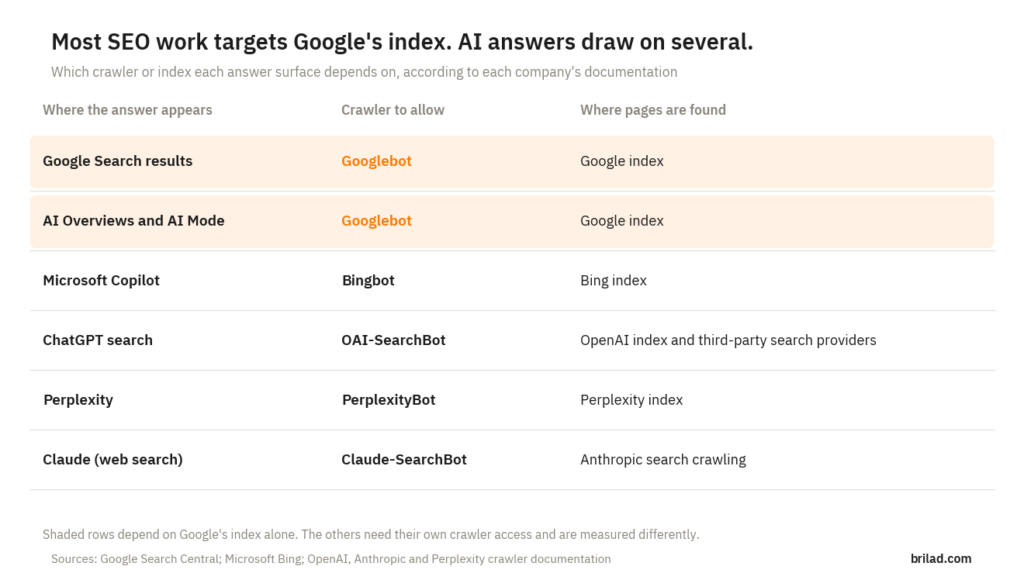
SEO work usually targets Google. AI answers draw on several sources: Google’s index for AI Overviews and AI Mode, Bing’s for Copilot, OpenAI’s own crawler and third-party search providers for ChatGPT, and separate crawlers for Perplexity and Claude. A site can be healthy in Google and still block OAI-SearchBot in robots.txt or at the firewall. You can check all of them with our free AI crawler access checker.
3. What others say about you carries more weight
Language models learn and retrieve what the web says about a brand, not only what the brand says about itself. In Ahrefs’ study of 75,000 brands, mentions of a brand on other websites correlated more strongly with visibility in Google’s AI Overviews than backlinks did. Seer found backlink counts had little relationship with ChatGPT mentions. For GEO, being described accurately and consistently on review sites, directories, industry publications and community discussions matters alongside links. See brand mentions and co-occurrence.
4. Queries are longer and split into parts
People ask assistants full questions with conditions: budget, size, location, existing tools. Systems split these into several searches, a technique Google calls query fan-out. A page can be cited for a question it never targeted because one section answers one of the sub-questions well. Keyword research alone does not reveal these sub-questions; sales calls, support questions and testing assistants directly do.
5. Measurement is harder
There is no Search Console for ChatGPT. GEO measurement relies on running a fixed set of buyer questions through each assistant repeatedly, because answers change between runs, and recording mentions, cited pages and whether the description of the brand is correct. Referral visits help too: ChatGPT adds utm_source=chatgpt.com to many of the links it shows, and other assistants appear as referring domains in analytics.
What does not change
- Pages must be crawlable, indexable and fast.
- Content must be helpful, accurate and written for people.
- Experience and expertise must be visible, with named authors and real evidence (E-E-A-T).
- Structured data should describe the page and the company accurately.
- Original information beats rewritten information (information gain).
Where to start
| Your situation | Start with |
|---|---|
| You rank well in Google but AI assistants rarely mention you | Check crawler access beyond Googlebot, then rewrite key pages into self-contained answers and work on mentions elsewhere |
| You do not rank and are not mentioned | SEO first: technical health, one clear page per topic, content that answers real questions |
| AI assistants mention you but describe you wrongly | Fix the facts at the source: your About page, profiles, directories and structured data (hallucination and grounding) |
| You are a new brand | Consistent company details everywhere, and a few pages with information nobody else has |
If you already rank but AI assistants still leave you out, work through our 7-point checklist for when ChatGPT does not mention your company.
Common misconceptions
“GEO replaces SEO”
Google’s AI features are built on its search index, and ChatGPT search draws on search results. Weak SEO limits GEO.
“An llms.txt file will get you into ChatGPT”
No major AI provider has said it uses llms.txt to choose citations, and Google has said it does not use it. It is cheap to add but not a GEO strategy. See what llms.txt is.
“Schema markup guarantees AI citations”
Google says no special structured data is needed for its AI features. Schema helps machines understand a page accurately, which is useful, but it does not buy placement.
“Anyone can guarantee a ChatGPT mention”
No one outside the AI companies controls their answers. GEO improves the odds and measures the change.
Frequently asked questions
Is GEO just SEO with a new name?
Largely it builds on SEO, but it adds work SEO usually skips: access for non-Google crawlers, passage-level writing, brand mentions across the web and tracking of AI answers.
Do I need separate content for GEO?
Usually not. The same pages serve both when each section answers a specific question directly and the page includes information other sources lack.
Is AEO the same as GEO?
They overlap. AEO, answer engine optimisation, targets answers shown on search results pages, such as featured snippets. GEO targets answers written by AI assistants. Both reward direct, well-structured answers. Our AEO and GEO service pages describe the differences in practice.
Sources
- Google Search Central, “AI features and your website”
- OpenAI Help Center, “Publishers and Developers FAQ”
- OpenAI, “Overview of OpenAI crawlers”
- Seer Interactive, “What drives brand mentions in AI answers?” (Christina Blake and Nick Haigler)
- Ahrefs, study of brand visibility factors in AI Overviews across 75,000 brands
- Aggarwal et al., “GEO: Generative Engine Optimization”, 2023