When ChatGPT does not mention your company, the cause is usually one of seven things: ChatGPT is not searching the web for that question, its crawler cannot reach your site, your pages do not appear in the search results it draws on, no page answers the specific question, your brand is confused with another, too few other sources mention you, or it knows about you but describes you wrongly. This checklist takes each cause in order, with a test for each and a free template for tracking the results.
Start by testing the right questions
“Does ChatGPT know us?” is not a useful test. Buyers do not ask for you by name; they ask for help with a problem. Write down 10 to 20 questions a real buyer would ask before choosing a company like yours, using the words your customers use in sales calls and emails. Mix three kinds:
| Type | Example for an SEO agency in Pune |
|---|---|
| Category | Which companies in India offer generative engine optimisation? |
| Problem | Why has our website traffic dropped since AI Overviews started appearing? |
| Comparison | What should a B2B company look for when hiring an AEO agency? |
Add a few brand questions too, such as “What does [your company] do?”, to check how you are described when someone does ask by name.
The seven checks
- Is ChatGPT searching?Check whether the answer shows sources.
- Can its crawler reach you?OAI-SearchBot, firewall, JavaScript.
- Do you appear in search?For the sub-questions, not just your brand.
- Does a page answer it?One section per question, answer first.
- Is your brand clear?One name, consistent details.
- Do others mention you?Reviews, directories, press.
- Is the description right?Trace wrong facts to the source.
1. Is ChatGPT searching the web for this question?
ChatGPT answers some questions from what the model learned in training and searches the web for others. When it searches, the answer shows source links. Without a search, the answer depends on training data, which you cannot change quickly. Run each question with search turned on, and note whether sources appear. If a question never triggers a search, focus on the questions that do, since those are the ones your current pages can influence.
2. Can OAI-SearchBot reach your pages?
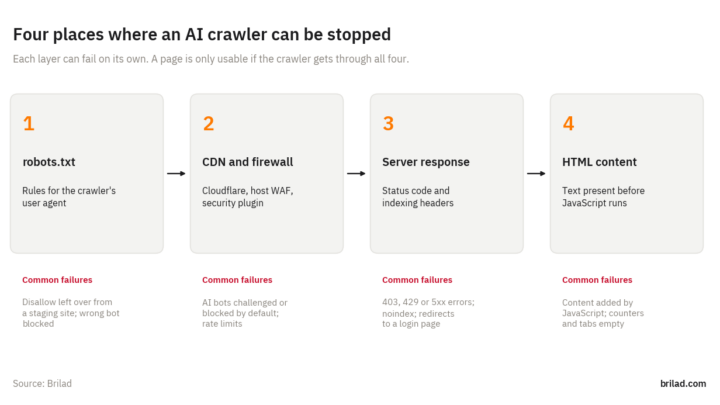
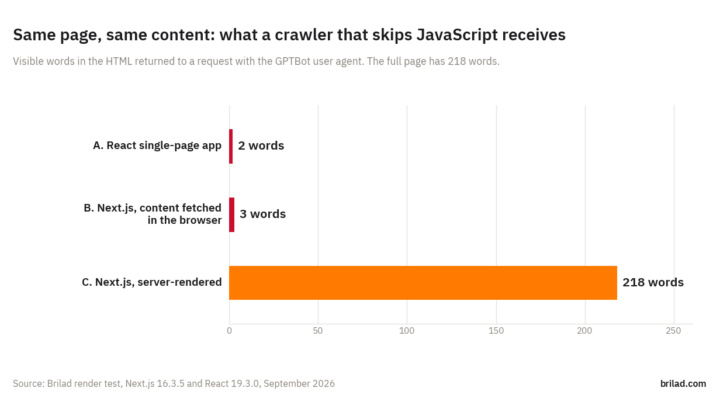
OpenAI’s publisher FAQ says any public website can appear in ChatGPT search, and that the requirement is not to block OAI-SearchBot. That crawler is separate from GPTBot, which collects training data. Check three things: your robots.txt does not disallow OAI-SearchBot, your CDN or firewall does not challenge it, and your pages send their text in the HTML rather than adding it with JavaScript. Our free AI crawler access checker tests all three in one command.
3. Do your pages appear in search for the sub-questions?
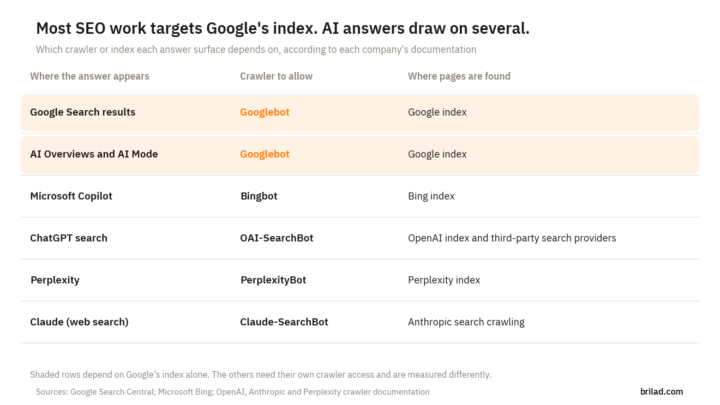
ChatGPT search uses OpenAI’s own crawling together with third-party search providers. Search visibility carries over: a study by Seer Interactive of 10,000 finance and SaaS questions found that ranking on page one of Google was strongly correlated with being mentioned in ChatGPT’s answers, while backlink counts were not.
Search rankings track ChatGPT mentions more closely than backlinks
Correlation with brand mentions in ChatGPT answers (0 = none, 1 = perfect)
- Page one of Google~0.65
- Bing rankings0.5 to 0.6
- Backlinks~0.10
Source: Seer Interactive, “What drives brand mentions in AI answers?”, 10,000 questions in finance and SaaS.
Assistants split long questions into smaller searches, so the relevant test is whether you appear for the parts of the question, such as “GEO services India” or “why traffic dropped after AI Overviews”. Check Google Search Console for impressions on those queries, and search Bing as well, since Bing’s index feeds Microsoft Copilot and is one of the sources other assistants can draw on.
4. Does one of your pages answer the question directly?
Assistants quote passages of a few sentences. If your answer to “what should we look for in an AEO agency” is spread over a long sales page, a competitor’s clear checklist will be quoted instead. For each test question, find the passage on your site that answers it. If there is none, write it: a heading phrased like the question, the answer in the first sentence, then the detail. Our guide on quotability has a six-point check for these passages.
5. Is your brand clearly identified?
If your company name is shared with another business, or appears in different forms across the web, ChatGPT may mix you up or leave you out. Search your exact name and see what else appears. Make your company name, address and people identical on your website, LinkedIn, Google Business Profile and directories, and link them with sameAs in your structured data. See entity resolution, sameAs and Wikidata.
6. Do other sources mention you in context?
Assistants build answers from several sources, and they tend to name companies that other sites also describe. In Ahrefs’ study of 75,000 brands, mentions of a brand on other websites were more closely linked to visibility in Google’s AI Overviews than backlinks were. Look at the sources ChatGPT cites for your test questions: if they are review sites, directories or industry articles that list your competitors and not you, those are the places to be listed.
7. Does ChatGPT describe you correctly?
Sometimes ChatGPT does mention you, but with a wrong description: an old service, a former office, a competitor’s feature. These errors usually come from an outdated page somewhere. Note every wrong fact and the source cited next to it, correct what you control, and report specific wrong answers with the feedback buttons in ChatGPT. More in our guide to hallucination and grounding.
Free tracking template
Answers change between runs, between days and between users, so a single test proves little. Run each question at least three times per assistant, once a month, and record the results. Copy the columns below into Google Sheets or Excel:
Date,Assistant,Question,Run,Brand mentioned (Y/N),Position in answer,Your URLs cited,Competitors named,Description accurate (Y/N),Notes
2026-10-01,ChatGPT,Which companies in India offer generative engine optimisation?,1,,,,,,
2026-10-01,ChatGPT,Which companies in India offer generative engine optimisation?,2,,,,,,
2026-10-01,Perplexity,Which companies in India offer generative engine optimisation?,1,,,,,,
After two or three months the sheet shows which questions you win, which competitors keep appearing, and which of your pages are cited. That is the baseline for deciding what to fix next.
Checks that do not help
- Asking ChatGPT once and treating the answer as final. Results vary between runs.
- Testing only your brand name. Buyers rarely ask that way.
- Adding llms.txt and expecting mentions. No major AI provider has said it uses the file to choose sources.
- Paying for “guaranteed” placement. No one outside OpenAI controls ChatGPT’s answers.
Frequently asked questions
How long after fixing something will ChatGPT mention us?
For answers based on web search, changes can show once OpenAI’s crawler revisits the page and the search sources update, often within weeks. For answers based on training data, it can take months, until the model is updated.
Does ChatGPT give different answers to different people?
Yes. Answers vary between runs, and ChatGPT can take account of a user’s earlier messages and saved memory. That is why the template records several runs.
Is this different for Perplexity and Gemini?
The checks are the same, but each uses its own crawler or index: PerplexityBot for Perplexity, and Google’s index for Gemini and AI Overviews. Run the same questions in each.
Sources
- OpenAI Help Center, “Publishers and Developers FAQ”
- OpenAI, “Overview of OpenAI crawlers”
- Seer Interactive, “What drives brand mentions in AI answers?” (Christina Blake and Nick Haigler)
- Ahrefs, study of brand visibility factors in AI Overviews across 75,000 brands