
The basics of AEO and GEO are the same in every industry: crawlers must be able to reach the site, pages must answer questions directly, and the company must be described consistently across the web. What changes by industry is what buyers ask, which sources AI systems trust, and how strict the standard of evidence is. This article sets out those differences for five sectors, using only what the search and AI providers have documented and what published research shows.
Why the sector matters
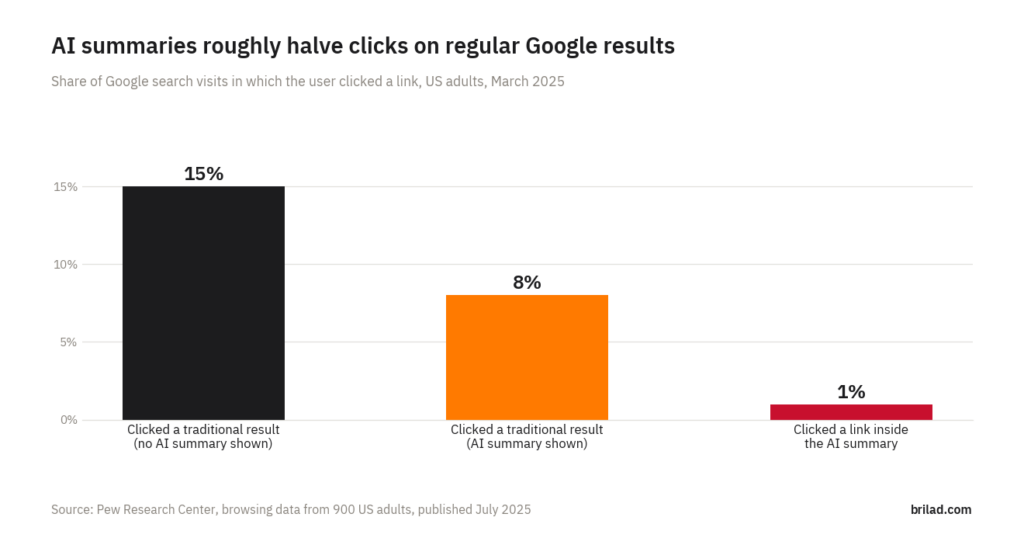
AI summaries change how people click. In a 2025 Pew Research Center study of US adults’ browsing, people clicked a regular Google result in 8% of visits when an AI summary appeared, against 15% when it did not. How much that matters depends on the question. A quick factual question may be answered completely on the results page. A software comparison, a medical question or a loan decision usually needs more than a summary, and the pages that are quoted in the summary are the ones most likely to get the click that follows.
Google’s Search Quality Rater Guidelines also treat topics differently. Health, finance, safety and other “Your Money or Your Life” (YMYL) topics are held to the highest standard of trust. That affects what content can rank and be cited in those sectors.
B2B software (SaaS)
Software buyers ask detailed comparison questions: which tool fits a given team size, budget, integration or compliance need. AI assistants answer these by combining several sources, which is described in our guide to query fan-out.
- Publish specific comparison pages with HTML tables: features, limits, integrations and pricing tiers side by side
- Keep a public pricing page, or at least state what the price depends on
- Make documentation crawlable as server-rendered HTML, since developers and AI coding tools read it directly
- Maintain consistent profiles on review platforms buyers use; they are among the independent sources that describe your product
- State who the product is not for. It helps assistants match you to the right buyers
E-commerce
Product questions depend on exact, current facts: price, availability, shipping, returns and compatibility. Google’s product structured data supports price, availability, shipping details and return policies, and these feed both search results and Google’s shopping features. OpenAI added product results to ChatGPT search in 2025.
- Use Product structured data with offers, shipping and return policy details that match the visible page
- Keep a Google Merchant Center feed accurate, since it is a separate source Google uses for product information
- Put short, direct answers to common fit and compatibility questions on category and product pages
- Make sure product details are in the page HTML, not loaded only by JavaScript after the page opens
Healthcare
Health content is the clearest YMYL case. Google’s rater guidelines ask whether information is accurate, comes from people with appropriate expertise, and reflects established medical consensus. AI systems face the same risk: a wrong health answer can cause harm, so they lean towards well-established, clearly attributed sources.
- Name the author and the medical reviewer, with their qualifications and a page about each
- Cite primary sources such as clinical guidelines and peer-reviewed studies, with dates
- Show when each page was last medically reviewed, and review pages on a schedule
- Keep promotional content separate from clinical information
- Avoid claims that go beyond the cited evidence
Financial services
Financial questions involve numbers that change: interest rates, fees, eligibility rules and regulations. Out-of-date figures are a trust problem for readers and for AI systems, which is why freshness signals matter more here than in most sectors.
- Show rates and fees in tables with the date they apply from
- Explain eligibility and costs in plain language near the top of product pages
- Include the regulatory disclosures that apply to you, such as those required by RBI or SEBI in India
- Name the people responsible for the content and their relevant experience
- Keep the details of each product and subsidiary clearly separated, so they are not confused with each other
Market research publishers
Research publishers usually have thousands of report pages on similar topics, which creates specific problems: near-duplicate pages competing with each other, summaries that look alike, and statistics quoted without their source. Their advantage is that they hold exactly the kind of original data AI systems prefer to cite.
- Put a short, dated summary of the report’s key findings at the top of each report page
- State the methodology and the period the data covers
- Consolidate pages that target the same market and region, instead of publishing many near-copies
- Use consistent names for markets and segments across all reports
- Give each headline figure its report title and publication date, so it can be cited correctly
What stays the same in every sector
| Requirement | Guide |
|---|---|
| AI search crawlers allowed; pages render without JavaScript | AI crawlers and robots.txt |
| Each section answers one question in its first sentence | Content chunking |
| Company and people described the same way everywhere | Entity resolution |
| Information competitors do not have | First-party evidence |
| Named, qualified authors | E-E-A-T for AI search |
Frequently asked questions
Is AEO or GEO harder in regulated industries?
The standard of evidence is higher, so thin or unsourced content does less well. Sites that already meet that standard, with named experts and cited sources, are well placed.
Does structured data work the same way in every industry?
No. Google uses some types, such as Product, for visible search features, while others, such as FinancialProduct or MedicalWebPage, exist in the schema.org vocabulary but do not produce special results. They can still help describe a page accurately.
Sources
- Pew Research Center, “Google users are less likely to click on links when an AI summary appears in the results”, July 2025
- Google, Search Quality Rater Guidelines (sections on YMYL topics and E-E-A-T)
- Google Search Central, “Product (Product, Review, Offer) structured data” and “Merchant listing structured data”
- OpenAI, announcement of shopping results in ChatGPT search, April 2025