
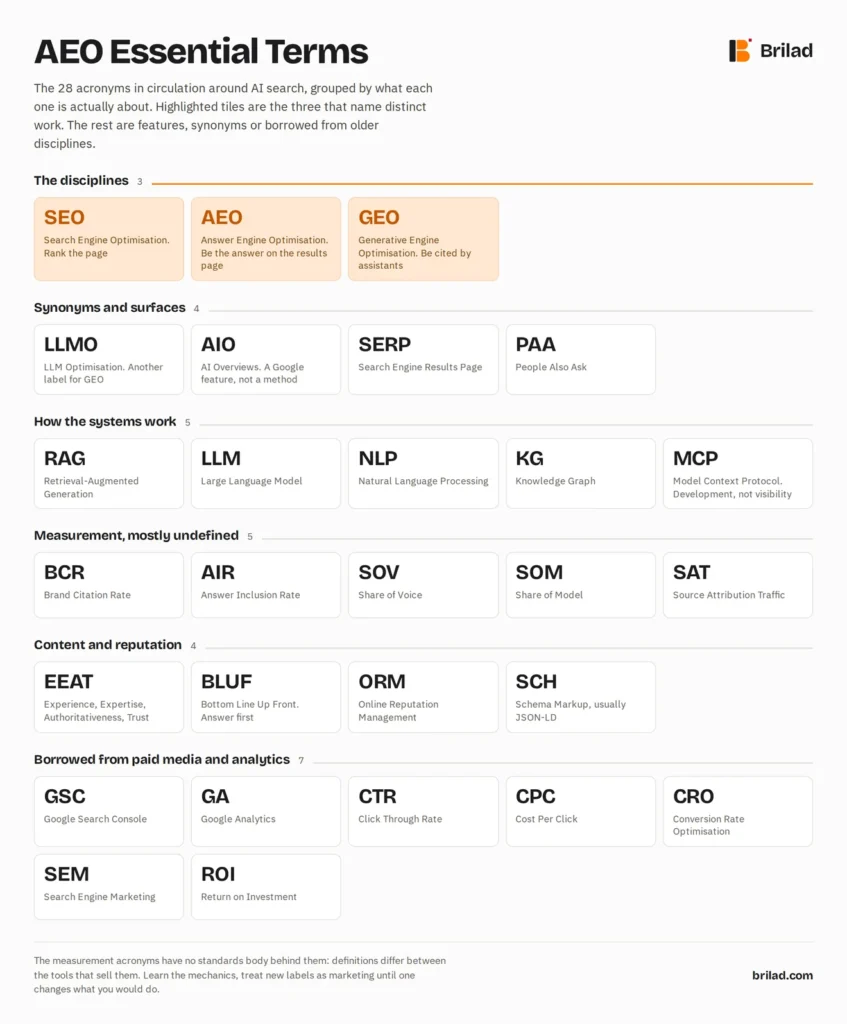
Three of the acronyms in AI search name genuinely different work, several are synonyms for each other, a few are product names rather than disciplines, and almost all of the measurement acronyms have no agreed definition at all. That last group causes the most damage, because two tools can report your “citation rate” and mean different things, and a team can argue for a quarter about a number neither side has defined. This article sorts the vocabulary into what is distinct, what is duplicated, what is a Google feature with a marketing name, and which three measurements are worth adopting.
The table above groups the 28 acronyms in circulation by what each one is actually about. Only three of them name distinct work, and those are the highlighted tiles.
Do AEO, GEO, AIO and LLMO mean different things?
Two of those four name distinct work. One is a product. One is a synonym.
| Term | What it actually names | Distinct? |
|---|---|---|
| SEO | Getting a page crawled, indexed and ranked | Yes, and it is the base layer under the rest |
| AEO, answer engine optimisation | Being the answer shown on a results page: featured snippets, People Also Ask, voice answers | Yes. The unit is a passage, and the page has to rank first |
| GEO, generative engine optimisation | Being named and cited inside an answer written by an assistant | Yes. Adds crawler access and brand identity to the content work |
| AIO, AI Overviews | A Google feature, the AI summary at the top of some results | No. It is a surface you appear in, not a discipline |
| LLMO, LLM SEO, AI SEO | The same work as GEO, under different labels | No. Different vendors, same activity |
The practical test for whether a new acronym deserves shelf space: does it change what you would do on Monday? AEO and GEO pass, because AEO sends you to passage structure and snippet formats while GEO sends you to crawler access and entity consistency. LLMO fails, because the work it describes is the work GEO already describes. AIO fails for a different reason: it is a thing that happens to you, like a featured snippet, not a method.
The term GEO has a traceable origin, which is rarer than it sounds in this field. It comes from a 2023 research paper by Aggarwal and colleagues, later presented at KDD 2024, which tested content changes against AI-generated answers. The differences between the three disciplines are set out in GEO vs SEO, and the snippet side in the AEO playbook.
Which of these are features rather than strategies?
A good portion of the vocabulary describes things on a page or inside a system. They are worth knowing and they are not things you “do”.
- SERP, PAA, AIO: places an answer can appear.
- KG, Knowledge Graph: Google’s store of entities and facts about them.
- SCH, schema markup: structured data you add to a page, usually as JSON-LD.
- RAG, retrieval-augmented generation: the method most assistants use to answer, which is why retrieval matters more than prompt wording. See how RAG works.
- LLM, NLP: the underlying technology, useful context and not a lever you pull.
- MCP, Model Context Protocol: an open protocol from Anthropic, released in November 2024, that lets assistants call tools and read data from other systems. It is a development subject, not a visibility one. If it is on your list because someone said it affects rankings, it does not. See building an MCP server.
- EEAT: experience, expertise, authoritativeness and trust, the qualities Google’s quality rater guidelines describe. It is a lens, not a score anyone can read. See E-E-A-T for AI search.
- BLUF, bottom line up front: a writing convention borrowed from military and government drafting that predates all of this. It is also, in practice, the single most useful habit on this list, because a passage that answers in its first sentence is the one an assistant can lift.
Why are the measurement acronyms the confusing part?
Because almost none of them are defined by anyone with authority to define them.
SEO inherited its vocabulary from Google, which documents what a canonical tag does and what noindex means. The AI visibility metrics have no equivalent. Brand citation rate, answer inclusion rate, share of model, source attribution traffic and share of voice are mostly vendor coinages, and the definitions differ between the tools that sell them. You can check this in ten minutes: open the documentation of any two AI visibility tools and compare what each counts as a citation.
| Metric | What it usually counts | What silently varies |
|---|---|---|
| Brand citation rate | How often your brand is cited in answers | Whether a linked source counts, a named mention counts, or both |
| Answer inclusion rate | How often you appear in answers to a defined prompt set | Whose prompt set, how many runs per prompt, and which platforms |
| Share of voice or share of answer | Your appearances against competitors on the same prompts | Whether the competitor list is yours or the tool’s default |
| Share of model | Something like presence within one assistant’s answers | Almost everything. This is the least settled of the group |
| Source attribution traffic | Visits arriving from an assistant | Which referrers are counted, and it misses everyone who never clicks |
None of this means the measurements are worthless. It means the number is only meaningful alongside its method, and that comparing your figure to someone else’s benchmark is usually comparing two different calculations.
What is the difference between a mention, a citation and a recommendation?
This distinction does more work than any acronym, and it is the one most often collapsed into a single number.
| What happened | What it tells you | What it takes to get there |
|---|---|---|
| Mention: the assistant names your company in the text | It knows you exist and considers you relevant | Consistent company facts across the web |
| Citation: one of your pages is listed as a source | It could reach, read and use your page | Crawler access, plus a passage worth quoting |
| Recommendation: it suggests you when asked who to use | It is confident about what you are | Identity signals plus third-party corroboration |
A company can be cited constantly and never recommended, which is a corroboration problem, not a content problem. The reverse also happens: recommended on reputation while none of your pages are ever cited, which usually means the pages cannot be retrieved. These need different budgets, so a single blended score hides the thing you most need to know. The staged version of this is in how AI search engines choose what to cite.
Which three questions should the vocabulary answer?
Rather than adopting twenty acronyms, pick the measurements that answer three questions. Everything else is reading material.
| The question | What to measure | Where it comes from |
|---|---|---|
| Can assistants reach and read us? | Whether each AI crawler fetches your key templates, and whether content is in the server HTML | A crawler check and a view of the raw page source |
| Are we named or cited? | Mention rate on a fixed prompt set, recorded per platform, with citation and recommendation counted separately | The same questions run monthly, logged out |
| How do we compare? | The same rate for the competitors you actually lose deals to, on the same prompts | Your own competitor list, not a tool’s default |
The method for the second and third rows is in the 15-minute AI visibility audit, with the repeat runs in tracking brand mentions, the competitive view in competitor analysis in AI answers, and the reporting in a visibility dashboard.
How many metrics should a team actually track?
Three, and the same three every month. The failure mode with a new vocabulary is adopting all of it, producing a dashboard nobody reads and a monthly meeting about definitions.
A workable set: mention rate on your prompt set, the share of that set where a competitor appears instead, and branded search volume from Search Console as a proxy for demand created upstream. The third one matters because an assistant that recommends you leaves no click behind, so the only trace is someone later searching your name. Full-funnel attribution covers why that gap exists, and reporting to leadership covers how to present it without overclaiming.
Which acronyms can you safely ignore for now?
Several on the typical list are real, useful and simply about something else. CPC, CTR, CRO, SEM, ROI, GA and GSC belong to paid media and analytics. They matter to a marketing team and they tell you nothing about whether an assistant can read your site. Keeping them in the same mental list as AEO and GEO is part of why the subject feels larger than it is.
ORM, online reputation management, is the genuine edge case. It sits in the old vocabulary but has become more directly relevant, because assistants assemble a description of a company from whatever the web says about it. An inaccurate third-party page is now a visibility problem as well as a reputation one.
What does better vocabulary not fix?
Naming a measurement does not make it measurable. Nobody outside the AI companies can see why a particular answer chose a particular source, and no tool can trace a specific deal back to an assistant’s recommendation. What can be measured honestly is whether you appear, on which questions, against whom, over time.
Agreeing on terms also does not settle whether the work is worth doing. That is a question about your buyers, and the answer comes from running the prompts they would actually type rather than from the vocabulary. If the questions your buyers ask return answers that never involve companies like yours, the right conclusion may be that this channel matters less for you than it does for your competitors.
And a glossary is not a strategy. Definitions for the full set of terms, kept in one place and updated as the field moves, are in the AEO and GEO glossary. This article is about which of them deserve a place on your reporting, which is a shorter list than any glossary suggests.
Frequently asked questions
Is AEO just a new name for SEO?
No. SEO decides whether a page is a candidate at all, because answer features and assistants both draw on pages that already rank. AEO is about whether a passage on that page is good enough to be lifted as the answer. The work is related and the unit being judged is different: a page for SEO, a passage for AEO.
Do I need to track LLMO separately from GEO?
No, they describe the same work. The only reason to know the term is that clients, tools and job adverts use it, so it is worth recognising rather than adopting.
Is brand citation rate a standard metric?
Not in the way that click-through rate is. There is no standards body and no platform documentation defining it, so each tool counts it slightly differently. Use it internally against your own baseline, and treat any cross-company benchmark with suspicion unless the method is published.
Which single metric should we start with?
Mention rate on a fixed set of 15 to 20 buyer questions, run monthly, logged out, recorded per platform. It is free, it needs no tooling, and it is the number that moves first when the underlying work is right.
Does MCP affect our AI search visibility?
No. The Model Context Protocol is about connecting assistants to tools and data, which is a development and security subject. It appears on AI search term lists because it is new and has an acronym, not because it changes whether you are cited.
How often does this vocabulary change?
The underlying mechanics change slowly: retrieval, passages and entity identity have been stable ideas. The labels change constantly, because most of them come from vendors differentiating their products. A reasonable rule is to learn the mechanics and treat new acronyms as marketing until one of them changes what you would do.
Sources
- Aggarwal, Murahari, Rajpurohit, Kalyan, Narasimhan and Deshpande, “GEO: Generative Engine Optimization”, KDD 2024, the origin of the GEO term
- Google Search Central documentation on AI features in Search, structured data and canonicalisation
- Google Search Quality Rater Guidelines, the source of the experience, expertise, authoritativeness and trust framing
- Anthropic, Model Context Protocol documentation, November 2024
- Observation rather than citation: the AI visibility metrics named here are defined by the vendors that sell measurement tools, and differ between them. Comparing the published definitions of any two such tools shows the variation directly.