Context Windows and Token Budgets in AI Search
What tokens, context windows and token budgets are, what gets cut from your page before a model reads it, and how to write for a limited budget.
What tokens, context windows and token budgets are, what gets cut from your page before a model reads it, and how to write for a limited budget.
Why B2B dashboards start counting the buyer too late, what Google retiring four attribution models in 2023 tells you, how AI answers widen the gap when only 1% of people click a source inside a summary, and what to put on the report instead of clicks.
Rohit Bhisey ·
Short, self-contained definitions of 62 terms used in answer engine optimisation, generative engine optimisation and technical SEO, with links to in-depth guides.
Gunakesh Parmar ·
What Pew's click data shows, how retrieval-augmented generation decides which sources an assistant credits, the four stages companies move through from absent to recommended, and the order of work that actually pays off.
Gunakesh Parmar ·
The accessibility fixes that also help search engines and AI systems: semantic HTML, headings, alt text, link text, captions, tables and keyboard access, with how to test them.
Ashruba Pankhade ·
Structure makes a page readable for AI assistants. It does not make the page worth quoting. How to find the original material only your company has, make it extractable, reinforce it across other surfaces, and measure whether assistants start naming you.
Rohit Bhisey ·
Why Microsoft Copilot depends on Bing's index, and seven steps to appear in its answers: Bing Webmaster Tools, IndexNow, Bingbot access, content, schema, Bing Places and measurement.
Gunakesh Parmar ·
How to tell genuine Googlebot, Bingbot and OpenAI crawler visits from impersonators using DNS checks and published IP ranges, with a free Python script for access logs.
Ashruba Pankhade ·
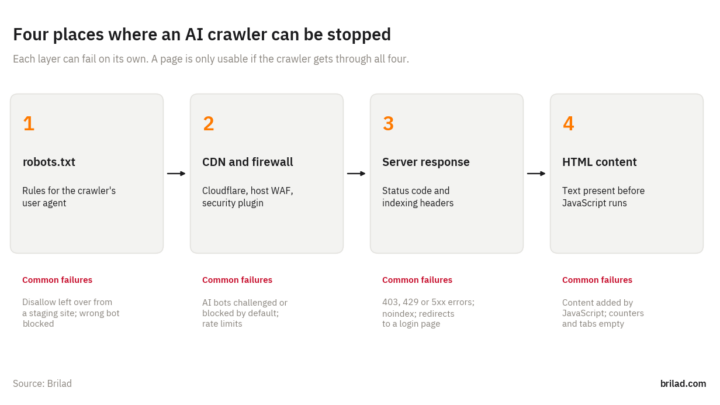
A step-by-step way to check robots.txt, your CDN or firewall, the server response and JavaScript rendering for ten search and AI crawlers, with a free Python script.
Ashruba Pankhade ·
How retrieval systems split pages into chunks, what makes a chunk usable on its own, and how to structure sections, headings and tables for it.
The 2023 Stanford study on why language models use information at the start and end of their input best, and how to write pages for it.
Retrieval-augmented generation, query fan-out, embeddings, re-ranking, context windows, the lost-in-the-middle effect and AI hallucination.
Guides on how Google, answer engines and AI assistants find, read and choose the sources they show.
Answer Engine Optimization: answer-first content, question schema and formatting that wins featured snippets and voice answers.