AI Hallucination and Grounding: What It Means for Brands
Why AI assistants state false things even when citing sources, what hallucinations look like for a business, and how to find and fix them.
Why AI assistants state false things even when citing sources, what hallucinations look like for a business, and how to find and fix them.
How interior designers and architects get found in search and AI answers: descriptive project pages, honest cost and process guides, credentials, Business Profile and reviews.
Rohit Bhisey ·
How hotels, homestays and tour operators compete with booking platforms in search and AI trip planning: complete profiles, detailed room and itinerary pages, clear policies, reviews and local guides.
Gunakesh Parmar ·
Short, self-contained definitions of 62 terms used in answer engine optimisation, generative engine optimisation and technical SEO, with links to in-depth guides.
Gunakesh Parmar ·
How to audit and improve what people and AI assistants see for your company name: your website, profiles, knowledge panel, similar-name confusion, negative results and monitoring.
Rohit Bhisey ·
How to handle images in Next.js for search, speed and AI understanding: the Image component, AVIF and WebP, the LCP image, alt text, file names, Open Graph images and structured data.
Ashruba Pankhade ·
How Google Gemini finds information, why the Google-Extended setting matters, and six steps to appear in Gemini's answers through Search, Maps, YouTube and a clear entity.
Gunakesh Parmar ·
The exact internal linking rules behind brilad.com: hubs, pillars, guides, services and blog posts, and how to apply the same hub-and-spoke structure to any site.
Gunakesh Parmar ·
Which AI crawlers an Indian business should allow or block, by type of business, with robots.txt examples and the legal context in India.
Gunakesh Parmar ·
A step-by-step method to measure how often ChatGPT, Perplexity and Gemini mention your brand, using a spreadsheet and Google Analytics instead of paid tools.
Rohit Bhisey ·
Seven reasons ChatGPT leaves a company out of its answers, a test for each, and a free template for tracking AI mentions over time.
Rohit Bhisey ·
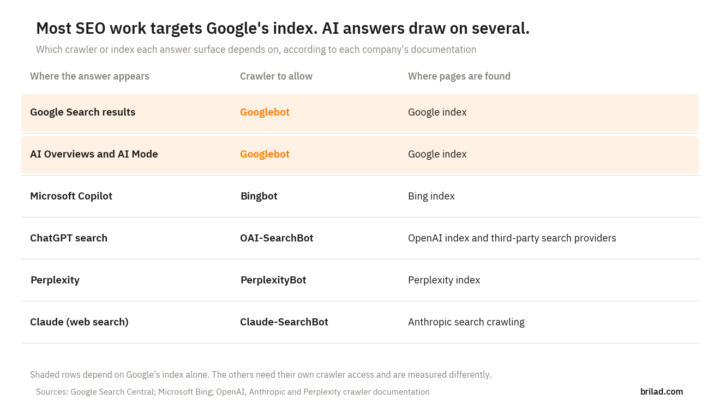
What really changes when you move from SEO to generative engine optimisation, what stays the same, and where to start, based on documentation from Google and OpenAI and published studies.
Gunakesh Parmar ·
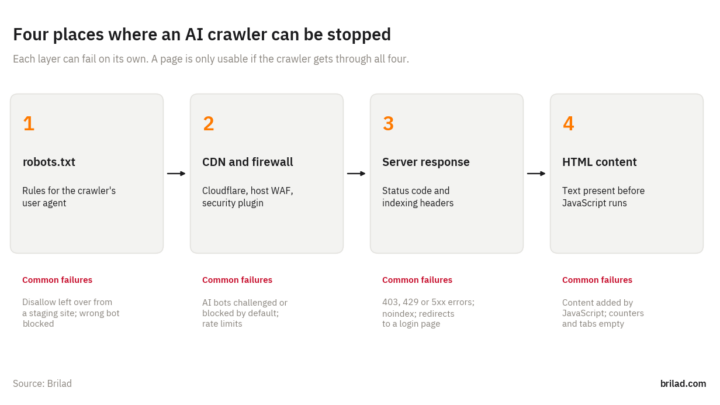
A step-by-step way to check robots.txt, your CDN or firewall, the server response and JavaScript rendering for ten search and AI crawlers, with a free Python script.
Ashruba Pankhade ·
How brand mentions and co-occurrence shape what AI assistants associate with your company, what is documented, and where useful mentions come from.
How visible dates, dateModified and sitemap lastmod work as freshness signals, what Google says about them, and when to update a page's date.
How search engines and AI systems decide that mentions refer to your company, and how consistent naming, sameAs and Wikidata fix confusion.
The training, search and user-fetch crawlers run by OpenAI, Anthropic, Perplexity, Google and others, and how to set robots.txt rules for each.
Answer-first structure, chunking, tables, JSON-LD, entity resolution, llms.txt, AI crawler rules, freshness dates and IndexNow.
Retrieval-augmented generation, query fan-out, embeddings, re-ranking, context windows, the lost-in-the-middle effect and AI hallucination.
Guides on how Google, answer engines and AI assistants find, read and choose the sources they show.
A full check of your visibility across Google, answer engines and AI assistants, with a prioritised fix list.
Generative Engine Optimization: AI crawler access, entity grounding, citable content and AI citation tracking for ChatGPT, Perplexity and Gemini.