How to Measure Brand Awareness From AI Search
Five signals that show whether appearing in AI answers is building awareness: branded search, direct and AI referral visits, share of voice, self-reported attribution and surveys.
Rohit Bhisey ·
Five signals that show whether appearing in AI answers is building awareness: branded search, direct and AI referral visits, share of voice, self-reported attribution and surveys.
Rohit Bhisey ·
How a new company can show experience, expertise and trust before it has case studies: visible people, publishable work, transparency and early independent signals.
Gunakesh Parmar ·
A practical process for collecting more genuine reviews: the right moment, a direct link through the right channel, one follow-up, replies to every review, and the practices to avoid.
Rohit Bhisey ·
How businesses with several locations win local search and AI answers: one verified profile per real location, unique location pages, crawlable store locators, per-location reviews and consistency.
Gunakesh Parmar ·
A page-by-page method for refreshing existing content: building an inventory, deciding to update, merge, redirect, remove or leave, what a real update includes, and how to measure it.
Gunakesh Parmar ·
Why B2B dashboards start counting the buyer too late, what Google retiring four attribution models in 2023 tells you, how AI answers widen the gap when only 1% of people click a source inside a summary, and what to put on the report instead of clicks.
Rohit Bhisey ·
How to replace keyword-only site search with hybrid semantic search in PostgreSQL, combine rankings with reciprocal rank fusion, and use visitors' searches to find content gaps.
Ashruba Pankhade ·
What logistics, freight and supply chain companies need to be found by shippers: specific service, lane and industry pages, facilities and certifications, listings and evidence.
Rohit Bhisey ·
Anthropic's three user agents explained, and six steps to be found and cited by Claude: access, readable HTML, precise answers, shareable pages, consistency and measurement.
Gunakesh Parmar ·
Short, self-contained definitions of 62 terms used in answer engine optimisation, generative engine optimisation and technical SEO, with links to in-depth guides.
Gunakesh Parmar ·
The six skills a marketing team needs for AI search, how to assess them, an eight-week plan using the team's own website, who owns what, and how to separate the knowledge that lasts from the part that changes every month.
Rohit Bhisey ·
A free baseline you can run in fifteen minutes: build a buyer question bank, test it on ChatGPT, Gemini and Perplexity, score the answers, check your footprint off your own site, and work out which of three problems you actually have.
Rohit Bhisey ·
What Pew's click data shows, how retrieval-augmented generation decides which sources an assistant credits, the four stages companies move through from absent to recommended, and the order of work that actually pays off.
Gunakesh Parmar ·
Structure makes a page readable for AI assistants. It does not make the page worth quoting. How to find the original material only your company has, make it extractable, reinforce it across other surfaces, and measure whether assistants start naming you.
Rohit Bhisey ·
Why WordPress sites fail Core Web Vitals and how to fix them without stacking plugins: field data, server caching, fewer scripts, the LCP image, layout stability and JavaScript control.
Ashruba Pankhade ·
A week-by-week 90-day plan for AEO and GEO: foundation and baseline in month one, a complete topic cluster in month two, original information and mentions in month three.
Rohit Bhisey ·
How Indian companies can become visible to buyers in the US, UK and Middle East: when to create market versions, URL structures, localised content, hreflang, local proof and measurement.
Gunakesh Parmar ·
How AI answers use video, and how to make your YouTube and on-site videos understandable: titles, descriptions, captions, chapters, watch pages, transcripts and VideoObject schema.
Rohit Bhisey ·
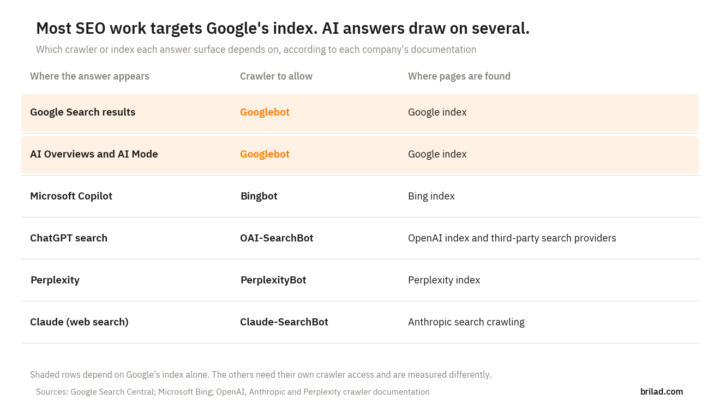
Why Microsoft Copilot depends on Bing's index, and seven steps to appear in its answers: Bing Webmaster Tools, IndexNow, Bingbot access, content, schema, Bing Places and measurement.
Gunakesh Parmar ·
How Google Gemini finds information, why the Google-Extended setting matters, and six steps to appear in Gemini's answers through Search, Maps, YouTube and a clear entity.
Gunakesh Parmar ·
What Indian institutes and edtech companies need on course pages, portals and local listings to be found and recommended, and how to publish outcome claims that are accurate and compliant.
Rohit Bhisey ·
How Perplexity finds and cites sources, and six steps to become one of them: crawler access, citable sentences, freshness, ranking for sub-questions, presence on cited sites and measurement.
Gunakesh Parmar ·
A step-by-step guide to appearing as a source in ChatGPT search: OpenAI's crawlers, access, readable content, answering buyer questions, search visibility and measurement.
Gunakesh Parmar ·
What is and is not known about AI assistants citing LinkedIn, and an eight-week test plan to find out whether LinkedIn or your website earns citations for your topics.
Rohit Bhisey ·
A copy-and-fill brief for hiring a GEO agency, the questions that separate strong agencies from weak ones, red flags in proposals and a scoring table.
Rohit Bhisey ·
How to find and fix slow Interaction to Next Paint on React and Next.js sites: measuring with attribution, shipping less JavaScript, transitions, splitting long tasks and taming third-party scripts.
Ashruba Pankhade ·
What Google has actually documented about AI Mode, what remains guesswork, and five strategy decisions that follow from the facts.
Gunakesh Parmar ·
How to divide marketing budget between performance campaigns and SEO and GEO, based on speed, sales cycle, cost per lead and demand, with a test-and-learn approach.
Rohit Bhisey ·
A monthly process to see which competitors AI assistants name for your buyers' questions, which sources drive those mentions, and what to do about each one.
Rohit Bhisey ·
A method for mapping the sub-questions AI assistants search when they answer a buyer's question, and assigning each one to a page, with a worked example.
Gunakesh Parmar ·
How to build a topic map that shows search engines and AI assistants your depth on a subject: core topics, buyer questions, page types, internal links and publishing order.
Gunakesh Parmar ·
Fifty SEO audit checks for 2026 in seven areas, from crawling and rendering to structured data, AI search readiness and measurement, with the tool for each.
Gunakesh Parmar ·
A step-by-step AEO playbook: choosing winnable queries, matching snippet formats, writing answer blocks, covering People Also Ask, and a 30-point checklist.
Gunakesh Parmar ·
A 100-point framework to assess how ready a website is for AI search, across crawler access, rendering, entity clarity, content, original information, off-site presence and measurement.
Gunakesh Parmar ·
A step-by-step method to measure how often ChatGPT, Perplexity and Gemini mention your brand, using a spreadsheet and Google Analytics instead of paid tools.
Rohit Bhisey ·
What really changes when you move from SEO to generative engine optimisation, what stays the same, and where to start, based on documentation from Google and OpenAI and published studies.
Gunakesh Parmar ·
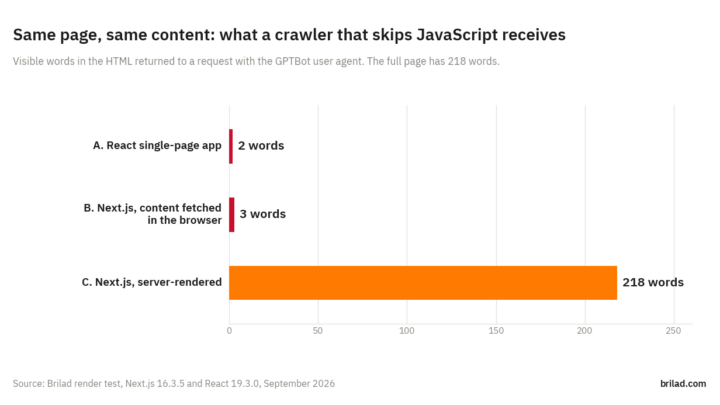
We built the same page three ways and requested each as OpenAI's crawler would. Two versions sent almost no content. Here is the test, the results and how to fix it.
Ashruba Pankhade ·
How Brilad collects, uses and protects personal data from website visitors and enquiries, and how to exercise your rights.
Brilad's eight-point checklist for pages that turn visitors from AI answers into enquiries, and how to measure AI referral traffic.
How common zero-click searches are, how AI answers combine several sources, and what to measure when clicks no longer tell the whole story.
What tokens, context windows and token budgets are, what gets cut from your page before a model reads it, and how to write for a limited budget.
What E-E-A-T means in Google's rater guidelines, why it matters to AI assistants, and a practical checklist for business websites.
What information gain is, why AI assistants cite pages that add something new, and how to find the information only your business can publish.
How to build one connected JSON-LD graph with @id and sameAs, what schema can and cannot do for rich results, and how to check it.
What embeddings and cosine similarity are, how search systems use them to match meaning, and what that means for how you write pages.
The 2023 Stanford study on why language models use information at the start and end of their input best, and how to write pages for it.
Information gain, E-E-A-T, first-party evidence, source attribution, trust signals and writing passages that can be quoted accurately.
Retrieval-augmented generation, query fan-out, embeddings, re-ranking, context windows, the lost-in-the-middle effect and AI hallucination.
Guides on how Google, answer engines and AI assistants find, read and choose the sources they show.
One-day on-site AEO and GEO workshop for marketing, content and development teams, led by Brilad's co-founders.
A full check of your visibility across Google, answer engines and AI assistants, with a prioritised fix list.
Generative Engine Optimization: AI crawler access, entity grounding, citable content and AI citation tracking for ChatGPT, Perplexity and Gemini.
Answer Engine Optimization: answer-first content, question schema and formatting that wins featured snippets and voice answers.
Technical and enterprise SEO: crawl health, Core Web Vitals, site architecture and intent-based keyword mapping.
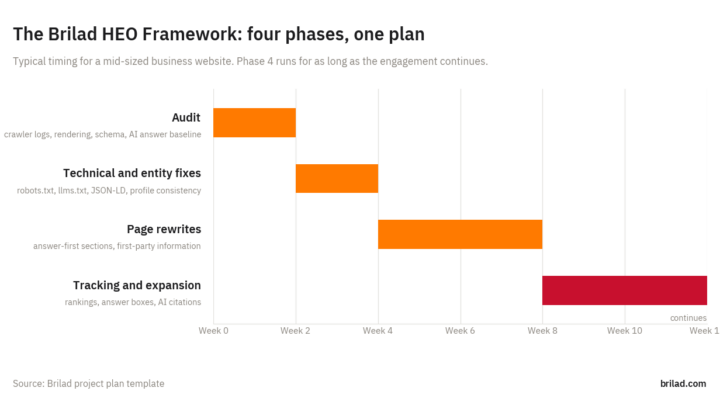
How Brilad plans SEO, answer engine optimisation and generative engine optimisation as one four-phase process, what each phase covers, and what it cannot promise.
Gunakesh Parmar ·