Automating Structured Data From Your CMS (With a Validation Script)
How to generate JSON-LD automatically from CMS fields, keep one connected graph per page, and validate it in your pipeline with a tested Python script.
Ashruba Pankhade ·
How to generate JSON-LD automatically from CMS fields, keep one connected graph per page, and validate it in your pipeline with a tested Python script.
Ashruba Pankhade ·
When template-generated pages help searchers and when they become scaled content abuse, the conditions for doing programmatic SEO well, and a small-batch process to test it.
Gunakesh Parmar ·
What Google has documented about AI Overviews, and six steps to be cited in them: eligibility, ranking for sub-questions, usable passages, expertise, query checks and measuring clicks.
Gunakesh Parmar ·
A QA process for AI-assisted articles: a tested script for banned phrases, links, structure and unsourced statistics, assisted claim checking, and human and expert review.
Ashruba Pankhade ·
How to turn a webinar or event into content search engines and AI assistants can use: an edited article, a Q&A page from real audience questions, a properly published video and a lasting event page.
Rohit Bhisey ·
How to build sitemaps for large sites: limits, splitting by type, sitemap index files, accurate lastmod, generateSitemaps in Next.js, image and video sitemaps, and monitoring.
Ashruba Pankhade ·
A page-by-page method for refreshing existing content: building an inventory, deciding to update, merge, redirect, remove or leave, what a real update includes, and how to measure it.
Gunakesh Parmar ·
Why B2B dashboards start counting the buyer too late, what Google retiring four attribution models in 2023 tells you, how AI answers widen the gap when only 1% of people click a source inside a summary, and what to put on the report instead of clicks.
Rohit Bhisey ·
How to replace keyword-only site search with hybrid semantic search in PostgreSQL, combine rankings with reciprocal rank fusion, and use visitors' searches to find content gaps.
Ashruba Pankhade ·
Short, self-contained definitions of 62 terms used in answer engine optimisation, generative engine optimisation and technical SEO, with links to in-depth guides.
Gunakesh Parmar ·
What Pew's click data shows, how retrieval-augmented generation decides which sources an assistant credits, the four stages companies move through from absent to recommended, and the order of work that actually pays off.
Gunakesh Parmar ·
How to audit and improve what people and AI assistants see for your company name: your website, profiles, knowledge panel, similar-name confusion, negative results and monitoring.
Rohit Bhisey ·
Structure makes a page readable for AI assistants. It does not make the page worth quoting. How to find the original material only your company has, make it extractable, reinforce it across other surfaces, and measure whether assistants start naming you.
Rohit Bhisey ·
How to handle images in Next.js for search, speed and AI understanding: the Image component, AVIF and WebP, the LCP image, alt text, file names, Open Graph images and structured data.
Ashruba Pankhade ·
How to stop filter combinations from flooding search engines with duplicate URLs, build indexable landing pages for the combinations people search, and handle pagination correctly.
Ashruba Pankhade ·
How to set up language URLs and hreflang in the Next.js App Router with the Metadata API or sitemap, avoid auto-redirects, and fix the most common hreflang mistakes.
Ashruba Pankhade ·
A practical SEO checklist for Laravel sites: URLs and redirects, titles and canonicals, JSON-LD, sitemaps with spatie/laravel-sitemap, rendering with Inertia, performance and proxies.
Ashruba Pankhade ·
The architecture of a website chatbot that answers from your own pages: chunking, embeddings in PostgreSQL with pgvector, grounded answers with citations, safeguards and evaluation.
Ashruba Pankhade ·
How to set up a headless WordPress and Next.js site for search and AI crawlers: server rendering, SEO fields, revalidation, public sitemaps, redirects and keeping the backend out of search.
Ashruba Pankhade ·
What Google has actually documented about AI Mode, what remains guesswork, and five strategy decisions that follow from the facts.
Gunakesh Parmar ·
The exact internal linking rules behind brilad.com: hubs, pillars, guides, services and blog posts, and how to apply the same hub-and-spoke structure to any site.
Gunakesh Parmar ·
Code for generating llms.txt and Markdown versions of pages in Next.js, keeping them out of Google's index, and an honest note on what llms.txt can and cannot do.
Ashruba Pankhade ·
A step-by-step diagnostic for traffic lost in a Google core update: confirming the cause, finding the losing pages and queries, studying the winners and deciding what to improve.
Gunakesh Parmar ·
A checklist for making Next.js sites readable by Google and AI crawlers: server rendering, the Metadata API, JSON-LD, sitemap and robots files, links, middleware and testing.
Ashruba Pankhade ·
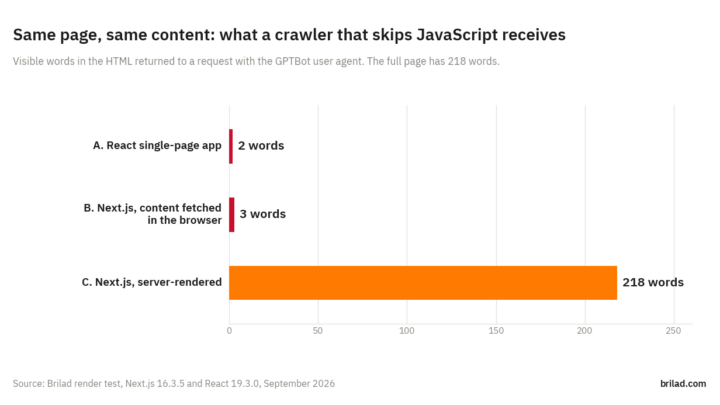
We built the same page three ways and requested each as OpenAI's crawler would. Two versions sent almost no content. Here is the test, the results and how to fix it.
Ashruba Pankhade ·
How IndexNow notifies Bing and other search engines of changed pages, why Google does not use it, and how to set it up on WordPress.
What first-party evidence and original research are, why AI assistants cite them, and how a services business can publish its own data properly.
How visible dates, dateModified and sitemap lastmod work as freshness signals, what Google says about them, and when to update a page's date.
Why AI assistants state false things even when citing sources, what hallucinations look like for a business, and how to find and fix them.
What information gain is, why AI assistants cite pages that add something new, and how to find the information only your business can publish.
How to build one connected JSON-LD graph with @id and sameAs, what schema can and cannot do for rich results, and how to check it.
The training, search and user-fetch crawlers run by OpenAI, Anthropic, Perplexity, Google and others, and how to set robots.txt rules for each.
What llms.txt is, its format, who uses it, what it can and cannot do for AI visibility, and how to add it to WordPress.
How AI search splits one question into many searches, what Google has said about it, and how to cover the sub-questions buyers never type.
How retrieval-augmented generation works, where pages drop out of AI answers, and how to make content easier for RAG systems to use.
Information gain, E-E-A-T, first-party evidence, source attribution, trust signals and writing passages that can be quoted accurately.
Answer-first structure, chunking, tables, JSON-LD, entity resolution, llms.txt, AI crawler rules, freshness dates and IndexNow.
Retrieval-augmented generation, query fan-out, embeddings, re-ranking, context windows, the lost-in-the-middle effect and AI hallucination.
AI-ready WordPress, Next.js and Laravel development, plus MCP servers and AI integrations.
Generative Engine Optimization: AI crawler access, entity grounding, citable content and AI citation tracking for ChatGPT, Perplexity and Gemini.