How to Report AI Search Results to Leadership: A One-Page Framework
A one-page monthly report for SEO and AI search: outcomes first, visibility trends against competitors, a short health check and three to five next actions.
Rohit Bhisey ·
A one-page monthly report for SEO and AI search: outcomes first, visibility trends against competitors, a short health check and three to five next actions.
Rohit Bhisey ·
A 100-point framework to assess how ready a website is for AI search, across crawler access, rendering, entity clarity, content, original information, off-site presence and measurement.
Gunakesh Parmar ·
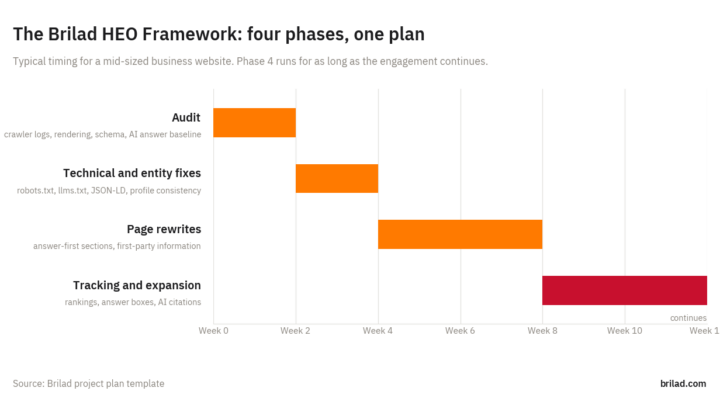
How Brilad plans SEO, answer engine optimisation and generative engine optimisation as one four-phase process, what each phase covers, and what it cannot promise.
Gunakesh Parmar ·
How consulting and professional services firms make their expertise visible to buyers and AI assistants: problem and industry pages, method, consultant profiles, case studies and original thinking.
Gunakesh Parmar ·
Why storing content as structured fields instead of one rich text block makes structured data automatic, facts consistent and content reusable by chatbots, with an example model for a service business.
Ashruba Pankhade ·
How Indian IT services and software companies get shortlisted by buyers and AI assistants: capability, technology and industry pages, engagement models, verifiable proof and review platforms such as Clutch.
Rohit Bhisey ·
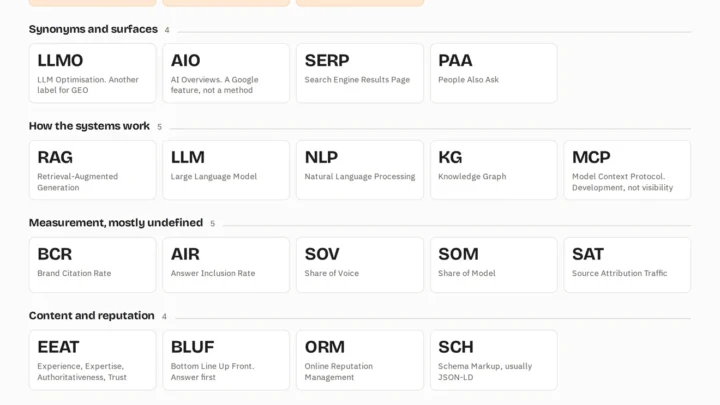
Two of the four acronyms name distinct work, one is a Google feature and one is a synonym. The measurement terms are the real problem, because brand citation rate and share of model have no agreed definition. Which three numbers to keep, and why the rest is reading material.
Rohit Bhisey ·
Knowing which accounts are worth winning, reaching the whole buying group, matching creative to the stage buyers are actually at, running demand creation alongside capture, and measuring against pipeline. What each capability fails to do alone, and the questions to ask before approving a campaign.
Rohit Bhisey ·
How to generate JSON-LD automatically from CMS fields, keep one connected graph per page, and validate it in your pipeline with a tested Python script.
Ashruba Pankhade ·
The trade-offs between an in-house SEO and GEO team and an agency, the questions that decide it, common hybrid models, and signs the current setup is not working.
Rohit Bhisey ·
Ten low-cost steps that give a startup search and AI visibility: a crawlable site, clear offer pages, visible founders, free tools, answer pages, one original asset, listings, reviews and a monthly check.
Rohit Bhisey ·
How a new company can show experience, expertise and trust before it has case studies: visible people, publishable work, transparency and early independent signals.
Gunakesh Parmar ·
Five signals that show whether appearing in AI answers is building awareness: branded search, direct and AI referral visits, share of voice, self-reported attribution and surveys.
Rohit Bhisey ·
How hacks damage search visibility, a prevention checklist for access, software, configuration and backups, and the steps to recover and request a review in Search Console.
Ashruba Pankhade ·
Why B2B dashboards start counting the buyer too late, what Google retiring four attribution models in 2023 tells you, how AI answers widen the gap when only 1% of people click a source inside a summary, and what to put on the report instead of clicks.
Rohit Bhisey ·
How to make Angular and Vue sites readable by Google and AI crawlers: Angular SSR and prerendering, Nuxt, per-route metadata, path-based routing and testing.
Ashruba Pankhade ·
The six skills a marketing team needs for AI search, how to assess them, an eight-week plan using the team's own website, who owns what, and how to separate the knowledge that lasts from the part that changes every month.
Rohit Bhisey ·
What Pew's click data shows, how retrieval-augmented generation decides which sources an assistant credits, the four stages companies move through from absent to recommended, and the order of work that actually pays off.
Gunakesh Parmar ·
A simple, defensible way to calculate return on SEO and GEO: choosing a baseline, counting incremental enquiries, converting them to profit, allowing for time, with a worked example.
Rohit Bhisey ·
How to divide marketing budget between performance campaigns and SEO and GEO, based on speed, sales cycle, cost per lead and demand, with a test-and-learn approach.
Rohit Bhisey ·
How to diagnose "Crawled, currently not indexed" on React and Next.js sites using Google's rendered view, match each symptom to its cause, and fix it.
Ashruba Pankhade ·
How to submit changed URLs to Bing and other IndexNow search engines from Next.js and Laravel, with working code, error codes and good practice.
Ashruba Pankhade ·
A checklist for making Next.js sites readable by Google and AI crawlers: server rendering, the Metadata API, JSON-LD, sitemap and robots files, links, middleware and testing.
Ashruba Pankhade ·
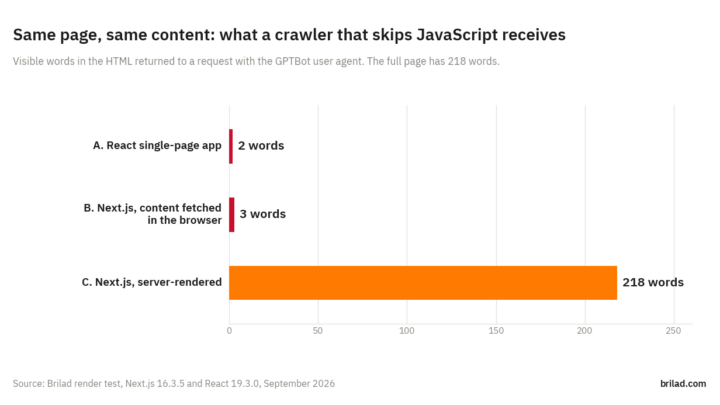
We built the same page three ways and requested each as OpenAI's crawler would. Two versions sent almost no content. Here is the test, the results and how to fix it.
Ashruba Pankhade ·
How retrieval systems split pages into chunks, what makes a chunk usable on its own, and how to structure sections, headings and tables for it.
What E-E-A-T means in Google's rater guidelines, why it matters to AI assistants, and a practical checklist for business websites.
Brilad is a search and web development consultancy in Pune and Mumbai founded by Gunakesh Parmar, Rohit Bhisey and Ashruba Pankhade.
A full check of your visibility across Google, answer engines and AI assistants, with a prioritised fix list.
Generative Engine Optimization: AI crawler access, entity grounding, citable content and AI citation tracking for ChatGPT, Perplexity and Gemini.
Technical and enterprise SEO: crawl health, Core Web Vitals, site architecture and intent-based keyword mapping.
SEO, AEO and GEO services, AI Search Audits and AI-ready development on WordPress, Next.js and Laravel.