E-E-A-T for New Companies Without Case Studies
How a new company can show experience, expertise and trust before it has case studies: visible people, publishable work, transparency and early independent signals.
Gunakesh Parmar ·
How a new company can show experience, expertise and trust before it has case studies: visible people, publishable work, transparency and early independent signals.
Gunakesh Parmar ·
A practical process for collecting more genuine reviews: the right moment, a direct link through the right channel, one follow-up, replies to every review, and the practices to avoid.
Rohit Bhisey ·
How businesses with several locations win local search and AI answers: one verified profile per real location, unique location pages, crawlable store locators, per-location reviews and consistency.
Gunakesh Parmar ·
How Indian vehicle dealers get found for local buying and service questions: separate showroom and service profiles, on-road price pages, dated offers, used stock pages and consistent listings.
Rohit Bhisey ·
How to build sitemaps for large sites: limits, splitting by type, sitemap index files, accurate lastmod, generateSitemaps in Next.js, image and video sitemaps, and monitoring.
Ashruba Pankhade ·
A page-by-page method for refreshing existing content: building an inventory, deciding to update, merge, redirect, remove or leave, what a real update includes, and how to measure it.
Gunakesh Parmar ·
What Indian insurers, brokers and aggregators need to rank and be cited: clear coverage and exclusions, waiting periods, claim processes, IRDAI disclosures, expert content and consistent listings.
Rohit Bhisey ·
How Indian law firms and advocates can build search and AI visibility within the Bar Council of India's rules: factual profiles, practice areas, legal explainers and a crawlable disclaimer.
Gunakesh Parmar ·
What Indian banks, NBFCs, fintechs and advisers need to rank and be cited: dated rates and fees, RBI, SEBI and IRDAI disclosures, expert content, calculators and consistent listings.
Gunakesh Parmar ·
How restaurants and cafes get recommended in Google, Maps and AI answers: a complete Business Profile, a text menu, consistent food platform listings, genuine reviews and a clear website.
Rohit Bhisey ·
The rules on company articles in Wikipedia and items in Wikidata: notability, conflict of interest, paid editing disclosure, and how to fix errors or add accurate, referenced facts.
Rohit Bhisey ·
Short, self-contained definitions of 62 terms used in answer engine optimisation, generative engine optimisation and technical SEO, with links to in-depth guides.
Gunakesh Parmar ·
The six skills a marketing team needs for AI search, how to assess them, an eight-week plan using the team's own website, who owns what, and how to separate the knowledge that lasts from the part that changes every month.
Rohit Bhisey ·
A free baseline you can run in fifteen minutes: build a buyer question bank, test it on ChatGPT, Gemini and Perplexity, score the answers, check your footprint off your own site, and work out which of three problems you actually have.
Rohit Bhisey ·
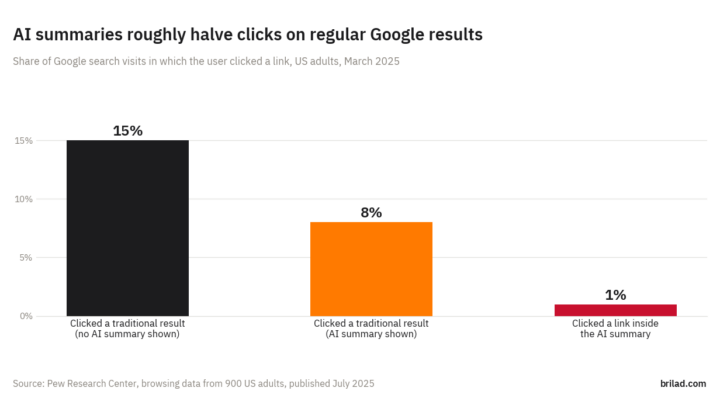
What Pew's click data shows, how retrieval-augmented generation decides which sources an assistant credits, the four stages companies move through from absent to recommended, and the order of work that actually pays off.
Gunakesh Parmar ·
The accessibility fixes that also help search engines and AI systems: semantic HTML, headings, alt text, link text, captions, tables and keyboard access, with how to test them.
Ashruba Pankhade ·
What Indian hospitals, clinics and health brands need to rank and be cited: verifiable doctor profiles, reviewed treatment pages, costs and insurance, listings, and compliance with advertising and data rules.
Gunakesh Parmar ·
How to audit and improve what people and AI assistants see for your company name: your website, profiles, knowledge panel, similar-name confusion, negative results and monitoring.
Rohit Bhisey ·
The pages, review profiles and documentation B2B SaaS companies need to be shortlisted by Google and AI assistants: use cases, integrations, pricing, comparisons and public docs.
Gunakesh Parmar ·
How Indian D2C brands can win organic and AI visibility against marketplaces: original product pages, legal disclosures, structured data, Merchant Center, category pages and guides.
Gunakesh Parmar ·
How Indian companies can become visible to buyers in the US, UK and Middle East: when to create market versions, URL structures, localised content, hreflang, local proof and measurement.
Gunakesh Parmar ·
How AI answers use video, and how to make your YouTube and on-site videos understandable: titles, descriptions, captions, chapters, watch pages, transcripts and VideoObject schema.
Rohit Bhisey ·
Why Microsoft Copilot depends on Bing's index, and seven steps to appear in its answers: Bing Webmaster Tools, IndexNow, Bingbot access, content, schema, Bing Places and measurement.
Gunakesh Parmar ·
How Google Gemini finds information, why the Google-Extended setting matters, and six steps to appear in Gemini's answers through Search, Maps, YouTube and a clear entity.
Gunakesh Parmar ·
What Indian institutes and edtech companies need on course pages, portals and local listings to be found and recommended, and how to publish outcome claims that are accurate and compliant.
Rohit Bhisey ·
A practical SEO checklist for Laravel sites: URLs and redirects, titles and canonicals, JSON-LD, sitemaps with spatie/laravel-sitemap, rendering with Inertia, performance and proxies.
Ashruba Pankhade ·
A step-by-step guide to appearing as a source in ChatGPT search: OpenAI's crawlers, access, readable content, answering buyer questions, search visibility and measurement.
Gunakesh Parmar ·
The structure of a service page that serves buyers, Google and AI assistants: a specific opening, fit, deliverables, process, price, evidence and real FAQs.
Gunakesh Parmar ·
How to divide marketing budget between performance campaigns and SEO and GEO, based on speed, sales cycle, cost per lead and demand, with a test-and-learn approach.
Rohit Bhisey ·
The exact internal linking rules behind brilad.com: hubs, pillars, guides, services and blog posts, and how to apply the same hub-and-spoke structure to any site.
Gunakesh Parmar ·
A one-page monthly report for SEO and AI search: outcomes first, visibility trends against competitors, a short health check and three to five next actions.
Rohit Bhisey ·
How local AI answers use business listings, and a checklist for Google Business Profile, location pages, reviews and the other platforms that feed Copilot, Siri and Indian directories.
Rohit Bhisey ·
A step-by-step guide to a free Looker Studio dashboard that combines GA4, Search Console and your AI answer tests to report AI visibility, visits and conversions.
Rohit Bhisey ·
How to submit changed URLs to Bing and other IndexNow search engines from Next.js and Laravel, with working code, error codes and good practice.
Ashruba Pankhade ·
How to earn accurate, relevant mentions in the publications and communities AI assistants read: finding targets, creating something worth covering, pitching and being a good expert source.
Rohit Bhisey ·
Fifty SEO audit checks for 2026 in seven areas, from crawling and rendering to structured data, AI search readiness and measurement, with the tool for each.
Gunakesh Parmar ·
How to structure comparison pages so buyers and AI assistants can use them: verdict first, a fair table on shared criteria, dated facts, clear conditions and open disclosure.
Rohit Bhisey ·
A step-by-step AEO playbook: choosing winnable queries, matching snippet formats, writing answer blocks, covering People Also Ask, and a 30-point checklist.
Gunakesh Parmar ·
How to find which review platforms and directories AI assistants cite for your category, and how to build profiles and collect genuine reviews that make you easier to recommend.
Rohit Bhisey ·
Which AI crawlers an Indian business should allow or block, by type of business, with robots.txt examples and the legal context in India.
Gunakesh Parmar ·
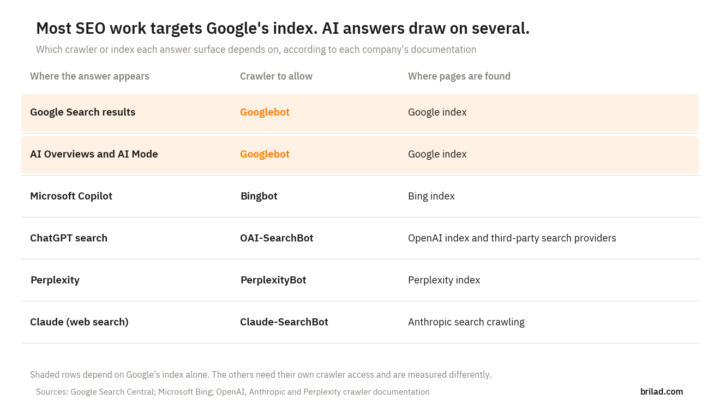
What Google, Microsoft and OpenAI say about structured data and AI answers, which schema types still produce results, and where schema causes problems.
Gunakesh Parmar ·
A step-by-step method to measure how often ChatGPT, Perplexity and Gemini mention your brand, using a spreadsheet and Google Analytics instead of paid tools.
Rohit Bhisey ·
Seven reasons ChatGPT leaves a company out of its answers, a test for each, and a free template for tracking AI mentions over time.
Rohit Bhisey ·
What really changes when you move from SEO to generative engine optimisation, what stays the same, and where to start, based on documentation from Google and OpenAI and published studies.
Gunakesh Parmar ·
How Brilad collects, uses and protects personal data from website visitors and enquiries, and how to exercise your rights.
How brand mentions and co-occurrence shape what AI assistants associate with your company, what is documented, and where useful mentions come from.
How IndexNow notifies Bing and other search engines of changed pages, why Google does not use it, and how to set it up on WordPress.
Why HTML tables and data-dense writing help search engines and AI assistants quote you accurately, and how to build tables machines can read.
How sparse retrieval (BM25), dense retrieval (DPR), hybrid search and cross-encoder re-ranking decide which passages reach an AI answer.
How visible dates, dateModified and sitemap lastmod work as freshness signals, what Google says about them, and when to update a page's date.
Why AI assistants state false things even when citing sources, what hallucinations look like for a business, and how to find and fix them.
What E-E-A-T means in Google's rater guidelines, why it matters to AI assistants, and a practical checklist for business websites.
How search engines and AI systems decide that mentions refer to your company, and how consistent naming, sameAs and Wikidata fix confusion.
The 2023 Stanford study on why language models use information at the start and end of their input best, and how to write pages for it.
How retrieval-augmented generation works, where pages drop out of AI answers, and how to make content easier for RAG systems to use.
Information gain, E-E-A-T, first-party evidence, source attribution, trust signals and writing passages that can be quoted accurately.
Answer-first structure, chunking, tables, JSON-LD, entity resolution, llms.txt, AI crawler rules, freshness dates and IndexNow.
Retrieval-augmented generation, query fan-out, embeddings, re-ranking, context windows, the lost-in-the-middle effect and AI hallucination.
Generative Engine Optimization: AI crawler access, entity grounding, citable content and AI citation tracking for ChatGPT, Perplexity and Gemini.
Answer Engine Optimization: answer-first content, question schema and formatting that wins featured snippets and voice answers.
Technical and enterprise SEO: crawl health, Core Web Vitals, site architecture and intent-based keyword mapping.
What changes in answer engine and generative engine optimisation for B2B software, e-commerce, healthcare, financial services and market research publishers, based on documented guidance and published research.
Gunakesh Parmar ·