How to Build an AI Visibility Dashboard in Looker Studio
A step-by-step guide to a free Looker Studio dashboard that combines GA4, Search Console and your AI answer tests to report AI visibility, visits and conversions.
Rohit Bhisey ·
A step-by-step guide to a free Looker Studio dashboard that combines GA4, Search Console and your AI answer tests to report AI visibility, visits and conversions.
Rohit Bhisey ·
Why FAQ sections still matter after Google limited FAQ rich results in 2023, where to find the real questions, how to write answers that get used, and the mistakes to avoid.
Gunakesh Parmar ·
How Indian IT services and software companies get shortlisted by buyers and AI assistants: capability, technology and industry pages, engagement models, verifiable proof and review platforms such as Clutch.
Rohit Bhisey ·
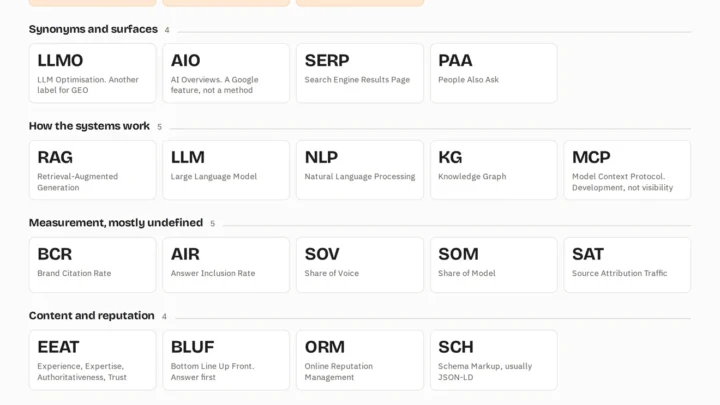
Two of the four acronyms name distinct work, one is a Google feature and one is a synonym. The measurement terms are the real problem, because brand citation rate and share of model have no agreed definition. Which three numbers to keep, and why the rest is reading material.
Rohit Bhisey ·
What crawl budget is according to Google, which sites need to care, where crawls are wasted, how to keep important pages crawled, and what does not help.
Gunakesh Parmar ·
Knowing which accounts are worth winning, reaching the whole buying group, matching creative to the stage buyers are actually at, running demand creation alongside capture, and measuring against pipeline. What each capability fails to do alone, and the questions to ask before approving a campaign.
Rohit Bhisey ·
How recruitment and staffing firms get found by candidates and employers: crawlable job pages with JobPosting markup, expired job handling, employer-facing service pages, trust signals and original salary data.
Rohit Bhisey ·
How to generate JSON-LD automatically from CMS fields, keep one connected graph per page, and validate it in your pipeline with a tested Python script.
Ashruba Pankhade ·
How interior designers and architects get found in search and AI answers: descriptive project pages, honest cost and process guides, credentials, Business Profile and reviews.
Rohit Bhisey ·
A Python script that sends buyer questions to Claude and Perplexity through their APIs with web search, records brand and competitor mentions and cited URLs, and saves the results for trend tracking.
Ashruba Pankhade ·
Ten low-cost steps that give a startup search and AI visibility: a crawlable site, clear offer pages, visible founders, free tools, answer pages, one original asset, listings, reviews and a monthly check.
Rohit Bhisey ·
How a new company can show experience, expertise and trust before it has case studies: visible people, publishable work, transparency and early independent signals.
Gunakesh Parmar ·
Five signals that show whether appearing in AI answers is building awareness: branded search, direct and AI referral visits, share of voice, self-reported attribution and surveys.
Rohit Bhisey ·
How search intent works now that questions carry conditions, continue across turns and mix several goals, how to identify it for any query, and which page format matches each intent.
Gunakesh Parmar ·
How to build sitemaps for large sites: limits, splitting by type, sitemap index files, accurate lastmod, generateSitemaps in Next.js, image and video sitemaps, and monitoring.
Ashruba Pankhade ·
What Indian insurers, brokers and aggregators need to rank and be cited: clear coverage and exclusions, waiting periods, claim processes, IRDAI disclosures, expert content and consistent listings.
Rohit Bhisey ·
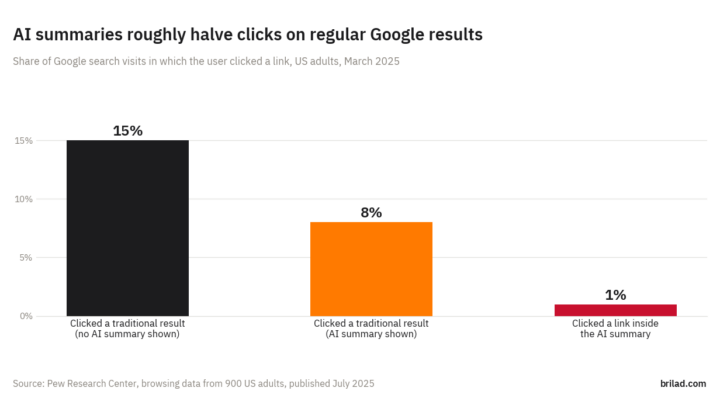
Why B2B dashboards start counting the buyer too late, what Google retiring four attribution models in 2023 tells you, how AI answers widen the gap when only 1% of people click a source inside a summary, and what to put on the report instead of clicks.
Rohit Bhisey ·
How Indian law firms and advocates can build search and AI visibility within the Bar Council of India's rules: factual profiles, practice areas, legal explainers and a crawlable disclaimer.
Gunakesh Parmar ·
What logistics, freight and supply chain companies need to be found by shippers: specific service, lane and industry pages, facilities and certifications, listings and evidence.
Rohit Bhisey ·
Go beyond Search Console's 1,000-row export: set up API credentials, run a Python script that pages through every query and page by day, and understand the data's limits.
Ashruba Pankhade ·
What Indian banks, NBFCs, fintechs and advisers need to rank and be cited: dated rates and fees, RBI, SEBI and IRDAI disclosures, expert content, calculators and consistent listings.
Gunakesh Parmar ·
How restaurants and cafes get recommended in Google, Maps and AI answers: a complete Business Profile, a text menu, consistent food platform listings, genuine reviews and a clear website.
Rohit Bhisey ·
Six design principles for AI agents that work with your website's data: narrow tools, read before write, human confirmation, defence against prompt injection, limits and logging, and data protection.
Ashruba Pankhade ·
The six skills a marketing team needs for AI search, how to assess them, an eight-week plan using the team's own website, who owns what, and how to separate the knowledge that lasts from the part that changes every month.
Rohit Bhisey ·
A free baseline you can run in fifteen minutes: build a buyer question bank, test it on ChatGPT, Gemini and Perplexity, score the answers, check your footprint off your own site, and work out which of three problems you actually have.
Rohit Bhisey ·
What Pew's click data shows, how retrieval-augmented generation decides which sources an assistant credits, the four stages companies move through from absent to recommended, and the order of work that actually pays off.
Gunakesh Parmar ·
The accessibility fixes that also help search engines and AI systems: semantic HTML, headings, alt text, link text, captions, tables and keyboard access, with how to test them.
Ashruba Pankhade ·
What Indian hospitals, clinics and health brands need to rank and be cited: verifiable doctor profiles, reviewed treatment pages, costs and insurance, listings, and compliance with advertising and data rules.
Gunakesh Parmar ·
Structure makes a page readable for AI assistants. It does not make the page worth quoting. How to find the original material only your company has, make it extractable, reinforce it across other surfaces, and measure whether assistants start naming you.
Rohit Bhisey ·
The pages, review profiles and documentation B2B SaaS companies need to be shortlisted by Google and AI assistants: use cases, integrations, pricing, comparisons and public docs.
Gunakesh Parmar ·
Automated checks that stop SEO mistakes before release: a tested smoke-test script for key URLs, Lighthouse CI budgets, crawl comparisons and redirect tests.
Ashruba Pankhade ·
How AI answers use video, and how to make your YouTube and on-site videos understandable: titles, descriptions, captions, chapters, watch pages, transcripts and VideoObject schema.
Rohit Bhisey ·
What Indian manufacturers and exporters need on product pages, company profiles and B2B marketplaces to be found by procurement teams in Google and AI answers, at home and abroad.
Rohit Bhisey ·
What is and is not known about AI assistants citing LinkedIn, and an eight-week test plan to find out whether LinkedIn or your website earns citations for your topics.
Rohit Bhisey ·
A copy-and-fill brief for hiring a GEO agency, the questions that separate strong agencies from weak ones, red flags in proposals and a scoring table.
Rohit Bhisey ·
How to diagnose "Crawled, currently not indexed" on React and Next.js sites using Google's rendered view, match each symptom to its cause, and fix it.
Ashruba Pankhade ·
A one-page monthly report for SEO and AI search: outcomes first, visibility trends against competitors, a short health check and three to five next actions.
Rohit Bhisey ·
A step-by-step method to find pages competing for the same queries using Search Console and a spreadsheet, and a decision table for merging, refocusing or redirecting them.
Gunakesh Parmar ·
How local AI answers use business listings, and a checklist for Google Business Profile, location pages, reviews and the other platforms that feed Copilot, Siri and Indian directories.
Rohit Bhisey ·
How to expose your Laravel application to AI assistants through the Model Context Protocol with the official laravel/mcp package, and the security design that matters most.
Ashruba Pankhade ·
A step-by-step diagnostic for traffic lost in a Google core update: confirming the cause, finding the losing pages and queries, studying the winners and deciding what to improve.
Gunakesh Parmar ·
A monthly process to see which competitors AI assistants name for your buyers' questions, which sources drive those mentions, and what to do about each one.
Rohit Bhisey ·
A method for mapping the sub-questions AI assistants search when they answer a buyer's question, and assigning each one to a page, with a worked example.
Gunakesh Parmar ·
Fifty SEO audit checks for 2026 in seven areas, from crawling and rendering to structured data, AI search readiness and measurement, with the tool for each.
Gunakesh Parmar ·
How to structure comparison pages so buyers and AI assistants can use them: verdict first, a fair table on shared criteria, dated facts, clear conditions and open disclosure.
Rohit Bhisey ·
How to tell genuine Googlebot, Bingbot and OpenAI crawler visits from impersonators using DNS checks and published IP ranges, with a free Python script for access logs.
Ashruba Pankhade ·
How to find which review platforms and directories AI assistants cite for your category, and how to build profiles and collect genuine reviews that make you easier to recommend.
Rohit Bhisey ·
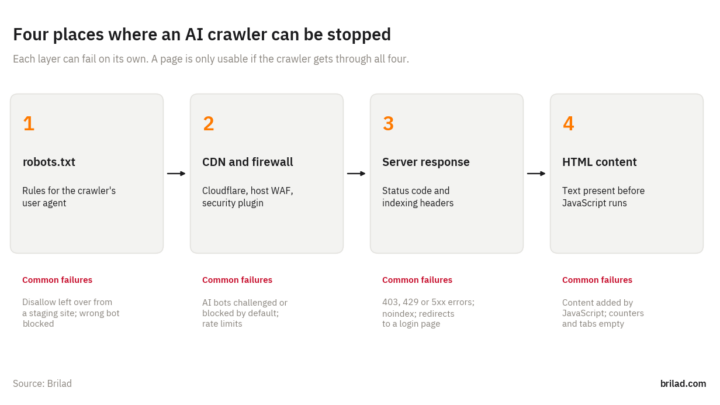
Five Cloudflare settings that can block ChatGPT, Claude and Perplexity crawlers even when robots.txt allows them, and how to allow AI search while keeping protection on.
Ashruba Pankhade ·
A step-by-step Search Console method to find queries where clicks fell while rankings held, confirm AI Overviews, and decide what to do about each one.
Rohit Bhisey ·
How long GEO takes, stage by stage: crawler fixes in days, content changes in weeks, brand mentions and model updates in months, and how to judge progress.
Rohit Bhisey ·
A step-by-step method to measure how often ChatGPT, Perplexity and Gemini mention your brand, using a spreadsheet and Google Analytics instead of paid tools.
Rohit Bhisey ·
Seven reasons ChatGPT leaves a company out of its answers, a test for each, and a free template for tracking AI mentions over time.
Rohit Bhisey ·
A step-by-step way to check robots.txt, your CDN or firewall, the server response and JavaScript rendering for ten search and AI crawlers, with a free Python script.
Ashruba Pankhade ·
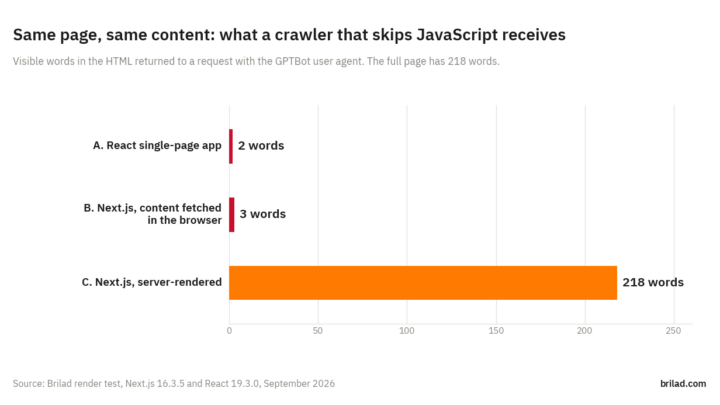
We built the same page three ways and requested each as OpenAI's crawler would. Two versions sent almost no content. Here is the test, the results and how to fix it.
Ashruba Pankhade ·
Brilad's eight-point checklist for pages that turn visitors from AI answers into enquiries, and how to measure AI referral traffic.
How brand mentions and co-occurrence shape what AI assistants associate with your company, what is documented, and where useful mentions come from.
How crawlers read your HTML, why semantic elements matter, the truth about text-to-HTML ratio, and a five-step machine readability test.
How knowledge graphs store facts as nodes and edges, how Google's Knowledge Graph and Wikidata work, and how to get your business represented.
Why HTML tables and data-dense writing help search engines and AI assistants quote you accurately, and how to build tables machines can read.
How visible dates, dateModified and sitemap lastmod work as freshness signals, what Google says about them, and when to update a page's date.
Why AI assistants state false things even when citing sources, what hallucinations look like for a business, and how to find and fix them.
How search engines and AI systems decide that mentions refer to your company, and how consistent naming, sameAs and Wikidata fix confusion.
What embeddings and cosine similarity are, how search systems use them to match meaning, and what that means for how you write pages.
The training, search and user-fetch crawlers run by OpenAI, Anthropic, Perplexity, Google and others, and how to set robots.txt rules for each.
The 2023 Stanford study on why language models use information at the start and end of their input best, and how to write pages for it.
How AI search splits one question into many searches, what Google has said about it, and how to cover the sub-questions buyers never type.
Answer-first structure, chunking, tables, JSON-LD, entity resolution, llms.txt, AI crawler rules, freshness dates and IndexNow.
Retrieval-augmented generation, query fan-out, embeddings, re-ranking, context windows, the lost-in-the-middle effect and AI hallucination.
One-day on-site AEO and GEO workshop for marketing, content and development teams, led by Brilad's co-founders.
AI-ready WordPress, Next.js and Laravel development, plus MCP servers and AI integrations.
A full check of your visibility across Google, answer engines and AI assistants, with a prioritised fix list.
Generative Engine Optimization: AI crawler access, entity grounding, citable content and AI citation tracking for ChatGPT, Perplexity and Gemini.
Answer Engine Optimization: answer-first content, question schema and formatting that wins featured snippets and voice answers.
What changes in answer engine and generative engine optimisation for B2B software, e-commerce, healthcare, financial services and market research publishers, based on documented guidance and published research.
Gunakesh Parmar ·